What It Says
The litmus test for good writing is whether the reader receives your intended message.
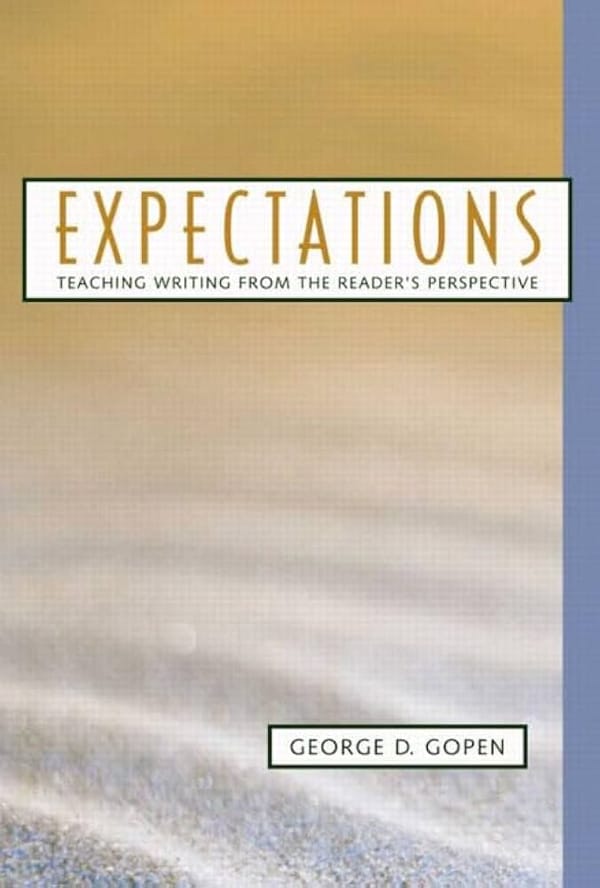
That's the core argument made by George D. Gopen in Expectations: Teaching Writing from the Reader's Perspective, a 400-page rhetoric published by Longman in 2004.
The book hinges on a single premise: that readers of English are not passive recipients of a writer's meaning, but active interpreters who bring a predictable set of expectations to every sentence they encounter.
Get your structure right, and readers will follow you effortlessly.
Get it wrong, and even the clearest thinking in the world will get lost in transit.
How It Works
Gopen, a professor at Duke University who was hired by Stanely Fish to lead the English department's writing program, builds his case through what he calls the Reader Expectation Approach (REA). The idea is that readers draw their interpretive cues not primarily from what words mean but from where those words appear in a sentence or paragraph.
In practice, this means readers are constantly asking five questions as they move through a text:
- What is going on here?
- Whose story is it?
- What is the most important piece of information in this sentence?
- How does this sentence connect to the one before it?
- How does it lean forward into the one that follows?
And crucially, readers look for the answers to those questions in specific structural locations.
The beginning of a sentence (what Gopen calls the topic position) tells readers whose story this is and links backward to what came before.
The end of a sentence (the stress position) is where readers intuitively expect the most important new information to land.
Gopen makes his case by working through real passages—the kind of dense, well-intentioned prose that fills academic journals, legal briefs, and corporate reports. He shows, sentence by sentence, why certain passages fail to communicate what their authors intended, then offers multiple revisions that make the underlying choices visible.
It reads less like a style guide and more like an eloquent script to a series of close-reading workshops.
What Sets It Apart
Most writing guides treat clarity as a matter of simplicity, and you've heard it all before:
- cut the jargon,
- shorten the sentences,
- get to the point.
Gopen's argument is slightly more nuanced: Clarity, he contends, is a structural phenomenon. A sentence can be grammatically perfect, lexically simple, and still fundamentally unclear, all because it puts the right information in the wrong structural location.
This reframing is what makes the book genuinely different. Rather than handing writers some checklist, it gives you a way of seeing your own prose from the outside—from the reader's side of the page.
The book also takes seriously something most writing guides quietly ignore: that a writer's job is not just to express thought but to recreate it in someone else's mind.
Who It's For
The intended audience is anyone who writes professionally and has ever suspected that the problem lies not in their ideas but in the way those ideas unfold on the page.
It's written primarily for writing instructors, and includes commentaries about pedagogical approaches to teaching these techniques and common points of confusion among students. But it's not a lesson plan; the book will be useful for for academics, scientists, lawyers, and other professional writers who deal in complex material that they need real readers 'to get.'
It's also an essential read for anyone with an interest in the genre of writing advice who are looking for something more systematic and principled than "show, don't tell" or "vary your sentence length."