Every time you write a sentence, you are doing three things at once:
- You are representing some piece of experience—an event, a state, a relationship between things. A quantum of time.
- You are positioning yourself in relation to that experience and to your reader—claiming authority, hedging uncertainty, inviting agreement.
- And you are organizing the information so it connects to what came before and points toward what comes next.
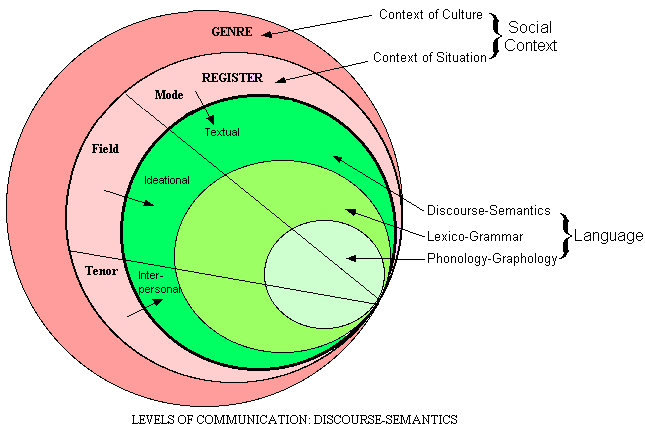
You probably don't think about any of this consciously. But the sentence won't work unless all three functions of language are aligned with its social context.
And when your writing fails, it fails in one of these dimensions.
This is the point of departure for Michael Halliday's An Introduction to Functional Grammar (Routledge: 1985). Where most writing instruction treats language as a system of rules for constructing correct sentences, Halliday treats language as a system of choices for making meaning.
What It Says
Language evolved, according to M.A.K. Halliday (1925 - 2018), to perform three functions, and its structure reflects that evolutionary pressure at every level. He calls these the three metafunctions of language, and the central claim of his book is that they operate simultaneously in every clause you write.
The first is the ideational function: language as a representation of experience.
Every clause encodes some process—something happening, someone doing something, a state of being—along with the participants involved and the circumstances surrounding them. The language choices you make at this level determine how you construe this quantum of time: what kind of agency you assign, what gets foregrounded as active and what gets buried as passive or circumstantial, what counts as a process and what counts as a thing.
So take question of the passive voice, a thorny issue in writing instruction. For example:
| Active: | I made a mistake. |
| Passive: | A mistake was made. |
Most writing teachers will give you blanket rules to avoid the passive voice because it's bad style. But on Halliday's account, the choice between active and passive voice isn't one of style but of experience and the representation of that experience.
The active voice encodes an experience of agency: there's a participant (I) who functions as an agent, carrying out a material process (make) onto a recipient (a mistake).
The passive voice tells a completely different story, namely one of passivity. In the subject position is not an agent but a recipient (a mistake), which receives the action of a passive verb (was made), without any mention of who carried out the action of that verb.
At the ideational level of meaning, each clause encodes different relationships between the event and its participants.
The second is the interpersonal function: language as an enactment of social relations.
Every clause also positions the writer in relation to the reader—claiming, questioning, demanding, offering. The grammatical systems that realize these relations include:
- mood (are you making a statement, asking a question, issuing a command?)
- modality (how certain are you? how obligated is your reader?)
- and the language choices that signal in-group status, solidarity, and distance.
Academic writers spend enormous energy on this function, usually without knowing it—hedging claims with "may suggest" instead of "proves," using passive constructions to sound neutral, choosing "we" or "I" based on field conventions about how much individual presence is permitted.
The third is the textual function: language as the organization of information into coherent discourse.
This is where the sentence connects to what surrounds it—what information do we consider given/understood versus what is new, what is foregrounded as the theme, how arcs of coherence are built through reference, repetition, and conjunction.
A sentence that is grammatically correct and semantically clear can still fail at this level, resulting in prose that reads as a series of disconnected statements rather than a developing argument.
How It Works
Halliday shows that ordinary clauses can be read simultaneously from all three angles, each yielding a different but compatible description.
Take a clause like
The government has failed to act.
At the ideational level, the clause represents a process with a participant (the government) and an implicit circumstance.
At the interpersonal level, it is a declarative assertion with positive polarity. The writer is committed to this claim.
At the textual level, "the government" is the theme, which means the sentence is telling a story about the government—it's the star of the show.
Change any of these and you change the meaning—not just the style, but the functions it performs, what the clause is doing in the world.
This triple-lens analysis is slow and unfamiliar at first. Halliday's terminology is dense and his framework requires patience. But the payoff is immense. It provides an account of language that actually explains why a writer's choices matter, rather than just prescribing which choices are correct.
What Sets It Apart
For writers wondering how to improve their craft, Halliday offers a refreshing new perspective. He reorients our attention from the formal aspects of language to its function.
Most grammar instruction is writer-oriented—here are the rules, here are the errors to avoid—which produces advice that is context-free by design.
Avoid the passive. Cut nominalizations. Keep sentences short.
Such advice isn't wrong so much as it's incomplete because, on Halliday's account, the question of whether a sentence works cannot be made independent of its context. The question, for example, of whether a passive construction works depends entirely on whether agency matters in that context, as described by the book's three levels of meaning.
Halliday gives writers a framework for making those judgments systematically. His Introduction provides not a new set of rules, but a way of asking better questions about what any given choice is doing for a specific reader in a specific situation.
Who It's For
Halliday writes primarily for linguists and language educators, and the book—at over 800 pages and weighing 3 lbs—is not easy reading. But its relevance to anyone serious about writing is hard to overstate.
The three metafunctions give writers a diagnostic framework that goes well beyond "is this clear?". They allow you to ask, specifically, whether your clause
- represents experience accurately,
- positions you appropriately in relation to your ideas and reader,
- and organizes information in the order your reader needs it.
Most writing problems, examined closely, turn out to be problems in one of these three dimensions. Halliday's Introduction to Functional Grammar provides a way of seeing them.