What It Says
Writing well isn't about memorizing rigid rules or imitating some mythical "correct" style, but about making deliberate choices that serve your readers.
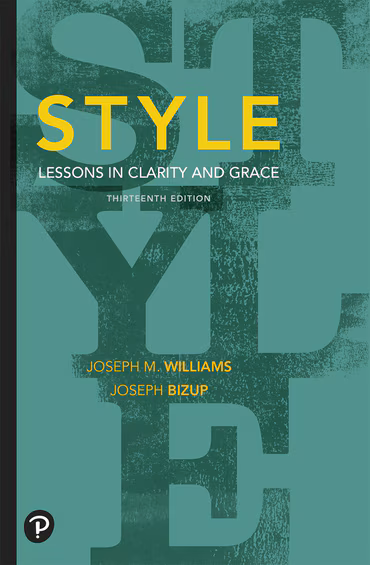
So argues Joseph M. Williams (18 August 1933 – 22 February 2008) in Style: Lessons in Clarity and Grace.
The book, first published in 1981 and now in its thirteenth edition, rests on two deceptively simple principles: (1) that it is good to write clearly, and (2) that anyone can learn to do it.
How It Works
Williams, an English professor at the University of Chicago, builds his case not through the familiar if vague platitudes one finds in most guides to writing ("be clear!" "be concise!") but through a refreshingly systematic method.
His approach is guided by the idea that if your sentence structure aligns with patterns readers naturally expect, and if your syntax mirrors the meaning you're trying to convey, your writing becomes easier to read.
In practice, this means techniques like...
- making real characters the subjects of your sentences,
- turning buried actions back into verbs (instead of hiding them in abstract nouns),
- and putting familiar information before new information so readers can follow your train of thought.
The book grew out of a legendary University of Chicago course called The Little Red Schoolhouse, and it reads like a course. Each chapter builds on the last, layered so readers develop an interconnected editing toolkit rather than collecting scattered tips.
What Sets It Apart
What makes the book stand apart from the crowd of writing guides is its attitude.
It treats grammar not as a list of rules but as a set of tools. This treatment is made explicit in the preface to the tenth edition, written by Williams's collaborator Gregory G. Colomb (September 5, 1951 – October 11, 2011):
The principles here may seem prescriptive, but that's not how they are intended. They are meant to help you predict how readers will judge your prose and then help you decide whether and how to revise it. (xi)
Towards the end of the book, Williams takes writing style seriously as an ethical matter, arguing that writers owe readers an ethical duty to write with precision and nuance, without assuming they owe us unlimited time to unpack our meaning.
Who It's For
The intended audience is broad—students, professionals, academics, anyone who has to put ideas into writing and needs those ideas to land.
It's not written primarily for writers of fiction, but its attention to reader psychology will be useful to writers of all genres.
Williams doesn't talk down to readers or assume they're starting from zero. He assumes you can handle complexity and asks only that you not inflict unnecessary complexity on others.
If you've ever stared at your own writing and thought, "Something is off here, but I can't figure out what," this book gives you a vocabulary and a method for diagnosing the problem. It won't tell you what to think. It'll teach you how to make what you already think come through on the page.