
Most of us think that literacy is pure gain. Learning to read opens us up to the world, and learning to write allows us to shape it—or so it would appear.
But what is lost in the trade?
Far from connecting us to the world, what if reading and writing is part of what's disconnecting us—not only from the natural world, but also from the full range of what language can actually do?
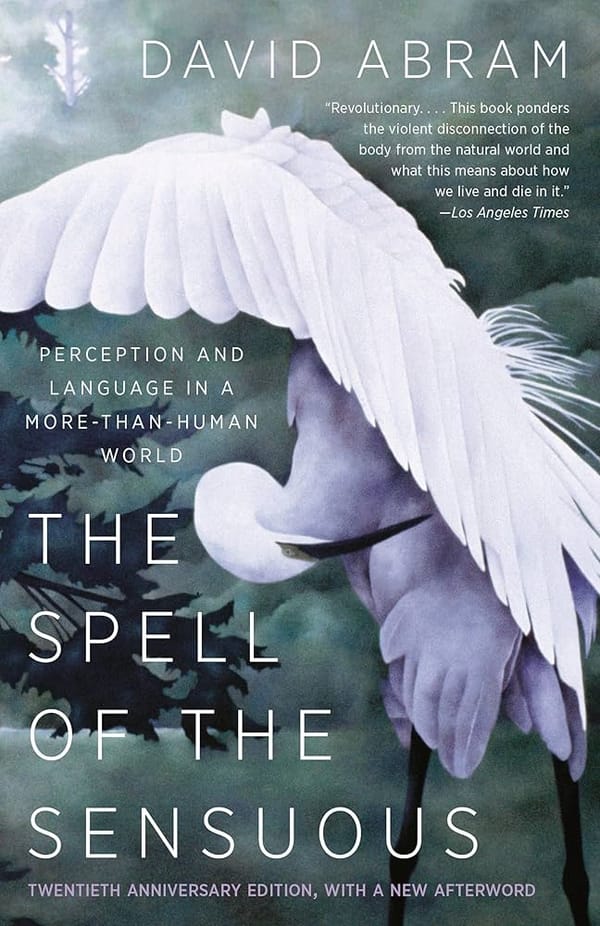
These are the questions David Abram puts to us in The Spell of the Sensuous (1996). A philosopher, ecologist, and sleight-of-hand magician, Abram writes with that rare combination of rigorous thinking and sensory vividness.
What It Says
His argument goes something like this: when the ancient Greeks developed their alphabet, something subtle yet profound shifted in human consciousness. By transforming language from fleeting sounds into abstract marks on a page—symbols that refer only to other symbols, rather than indexing the living world around us—alphabetic writing gradually pulled our attention inward, into an exclusively human conversation.
We stopped reading the landscape and started reading pages.
How It Works
Drawing on the phenomenology of Merleau-Ponty, on his own fieldwork with indigenous communities in Southeast Asia and the American Southwest, and on the history of writing itself, Abram argues that cultures rooted in oral communication never made this split. Their languages maintain a living relationship with the sensory world—and so, he suggests, do their speakers.
What Sets It Apart
Most writing guides tell you to show, not tell. But few explain why that distinction matters.
Abram does. His central claim is that the human brain is not designed to deal with abstract ideas. On the contrary, it is designed to receive sensory experience, out of which ideas are then built.
This isn't a mere style tip. Writing that leads with abstraction, on Abram's account, works against the grain of how the reader's mind actually perceives the world.
What makes the book special is the way the book serves to illustrate its own point. Rather than demonstrating abstraction on every page while warning against it, Abrams writes with a lyricism, rhythm, texture, and the kind of lively specificity that puts you inside an experience rather than handing you a summary of one.
The book is itself an example of the kind of writing for which it argues.
Who It's For
That lesson is one most writers need.
One of the most common pieces of feedback new writers receive is some version of: this is interesting, but I feel like I'm reading about the story rather than experiencing it.
Abram offers an account for how that gap between reading and experiencing cleaves. The root problem, he argues, is that we've been trained to lead with abstraction. We aim to communicate our ideas rather than our experiences. But these messages fall flat because our readers don't absorb concepts; they absorb experiences, and it's from those experiences that concepts are derived.
Writing that remembers this phenomenology feels alive. Writing that forgets it tends to feel—no matter how clever—like a summary, a secondhand report of experience instead of the genuine article.