You know what an introduction is for.
It gets your reader ready—supplies the context, defines the unusual terms, signals where the piece is heading.
That preparation makes your ideas easier to follow—right?
Not quite.
That model of introductions rests on a premise that kills a lot of writing from the start: that a reader who can understand you will want to keep reading.
Readers don't work that way.
They don't read because they can follow your sentences; they read when they perceive value.
Fail to establish that value up front, and they bounce at line four.
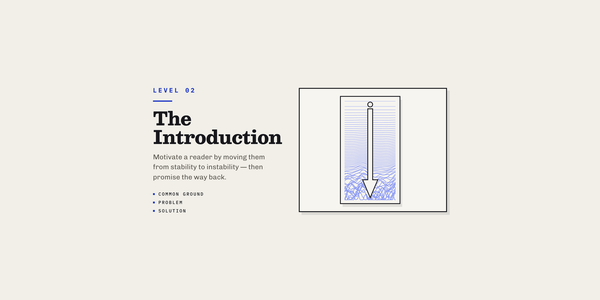
So your opening is not there to prepare your reader. It's a controlled demolition:
- you take a belief they are standing on,
- show them the crack in it,
- tell them what the crack is costing them,
- and hand them your point as the repair.
We can do that in five moves.
But first, it's important to understand value. As any entrepreneur will tell you, value is the solution to a problem.
So before you can provide value, problems come first.
A Problem Has Three Parts
Many writers open by announcing a topic. They expect the reader to supply the interest.
The reader declines, because a topic puts nothing at stake.
A topic is a region; a problem is a condition with a cost that somebody pays.
And only the second one generates interest and motivates readers to read.
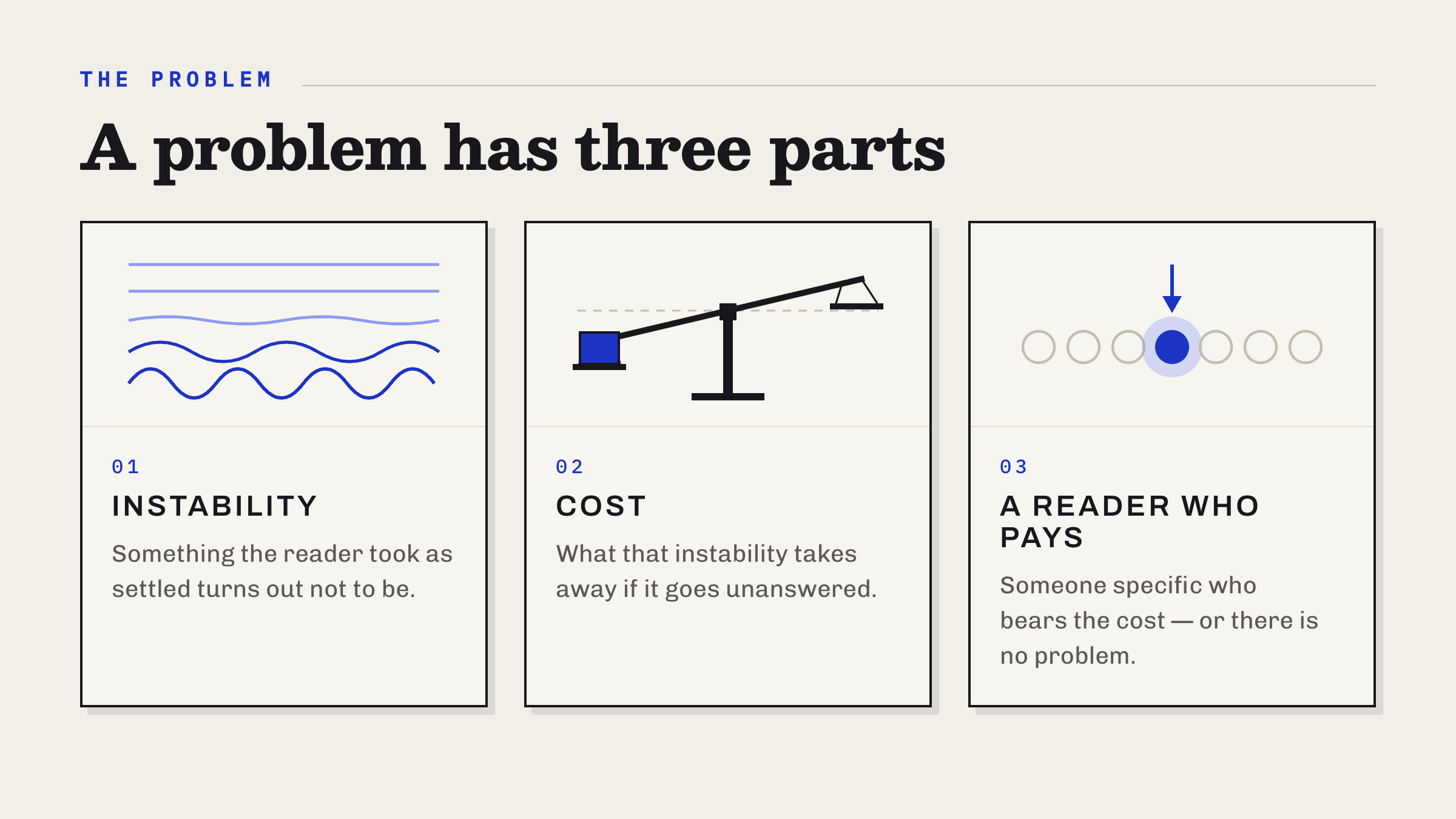
In order for your reader to perceive a problem, three elements are needed:
An instability.
Something that doesn't fit, doesn't hold, won't reconcile.
Something contradicted by the evidence, or unaccounted for, or missing where it ought to be.
The word to keep is unstable: a problem is a situation that won't settle.
A cost.
An instability alone is not a problem; it's just noise.
What intolerable price must be paid by the reader (or someone they care about) if that instability stays unresolved?
Or, less often, what benefit will they gain by resolving it? (But humans will pay more to avoid pain than to gain a benefit, so it's better to focus on cost.)
Most writers skip this part.
A reader who pays it.
Not "an audience."
A specific person or group whose situation the cost lands in.
The same instability makes a different problem for different people, or no problem at all—which is why you cannot draft an introduction until you know who is on the other side of it.
An instability, a cost, a reader—those parts are what a problem is.
Five moves are how a problem gets built on a page.
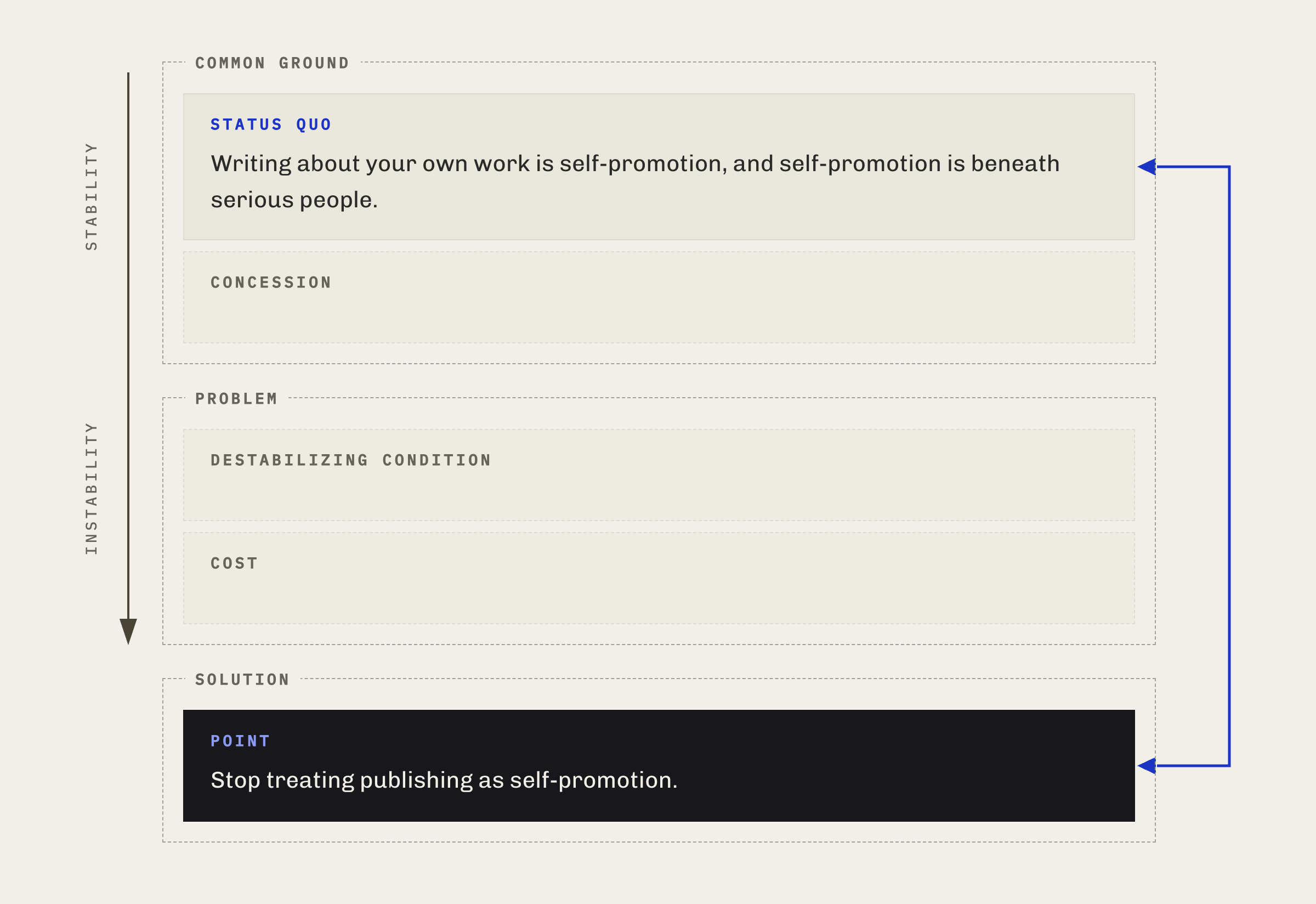
Before any of that, though, notice where your Point sits in the structure: if your opening breaks something, your Point repairs it.
The introduction opens a crack in your reader's situation, and the Point of your piece promises to close it.
Five Moves for Your Introduction
If you want readers to see the value of your idea, use your introduction to walk them through these five stations:
- Find the Status Quo by Inverting Your Point
- Concede What's True, Useful, or at least Understandable
- "But"—The Destabilizing Condition
- Price the Cost
- Make Your Point
1. Find the Status Quo by Inverting Your Point
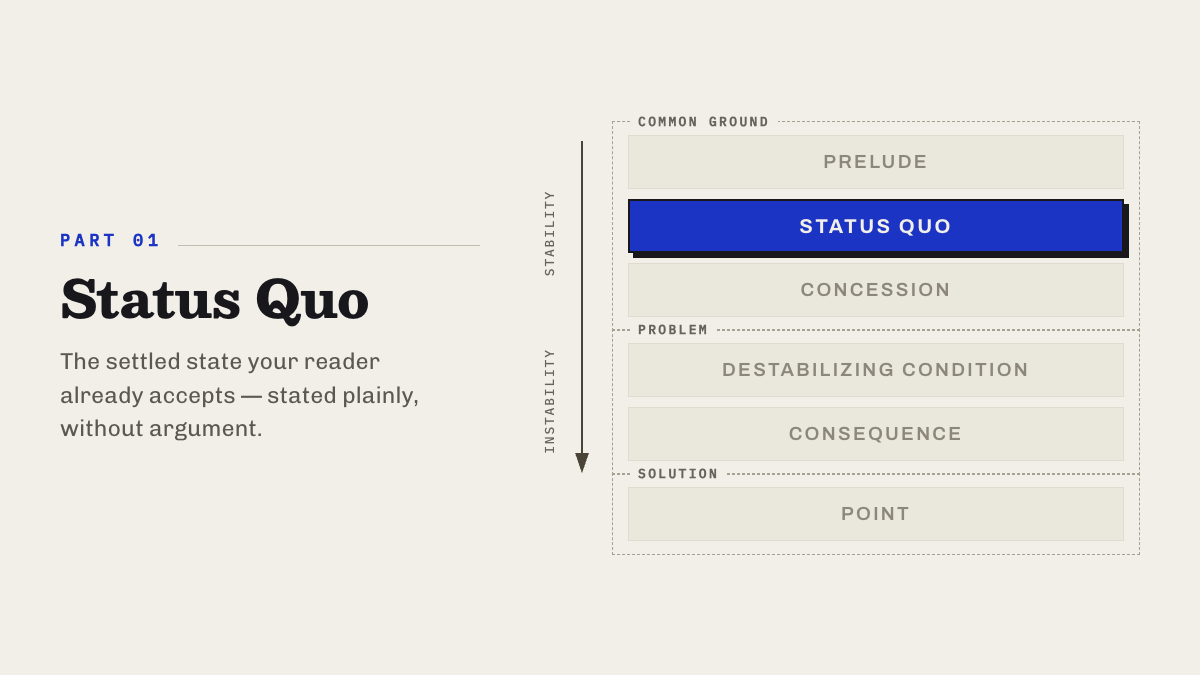
You can't crack a belief that you haven't stated.
The belief you need isn't hiding anywhere, either—it is encoded in your point, backwards, because a point that displaces nothing didn't need writing. Invert your point and you have the sentence your reader would say today.
If your point is
Stop treating publishing as self-promotion
the belief you are displacing is
writing about your own work is self-promotion, and self-promotion is beneath serious people.
So open there, stated squarely enough that your reader nods along.
Two things to watch out for that can make this opening move go wrong:
- Opening with a belief your reader doesn't hold. The idea is to open in a place where the reader can see themself (or someone whom they care about). If they wouldn't nod along, you're not writing for them. A Point that displaces nothing your reader believes is a Point they have no reason to receive.
- The belief gets implied instead of stated. Watch what happens with a list of negations:
A writer I worked with was profiling a software company that had grown large and profitable while dismantling nearly everything its industry treats as standard equipment.
He opens with an inventory of what the company doesn't have:
No product managers. No standing teams. No quarterly targets. No A/B tests.
If you already know a little about software product development, that might make sense.
But read it as a stranger: Four subtractions, and no picture of what's left over.
Each line makes sense only if the reader believes that all companies have those.
But if the reader is outside the industry, they won't have the background knowledge needed to surface the implied belief that your Point eventually overturns.
The reader never agreed to it, and an agreement they never made can't be broken.
To fix this, we'd want to open with a sentence in front of the list—e.g.:
Somewhere between five people and fifty, every company installs the same machinery: someone to own the roadmap, targets to tell you whether it worked, tests so you aren't guessing.
Now the four absences are positioned against a belief to break.
Keep the explicit version short—one or two sentences, in your reader's own words. Don't explain to them what they already know. Just prompt them to call up the belief so they start off on some solid ground.
This is the floor you are about to break.
2. Concession
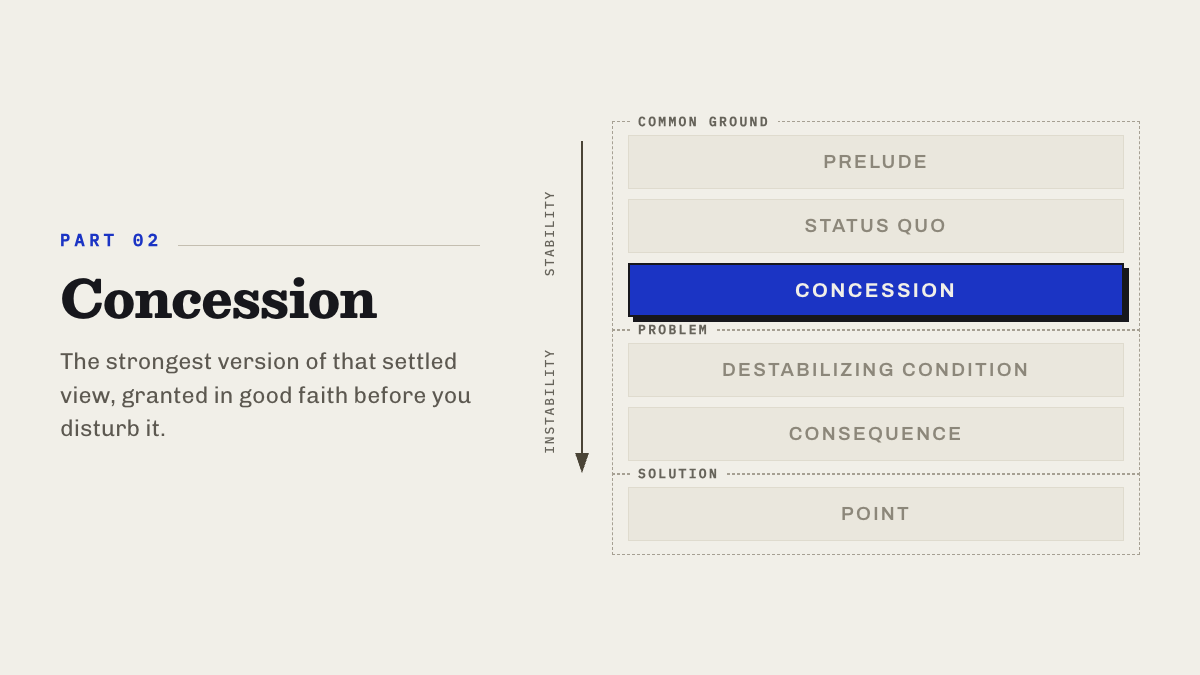
Having stated the belief, you'll want to get past it and start dismantling.
Resist that.
The next sentence is the most deletable-looking one in your introduction, because it argues against your own Point.
But it's important to your credibility. This sentence decides whether your reader hears a colleague or an antagonist.
Be gracious. Generous even. Grant what the belief has bought them.
Returning to our model introduction about writers and self-promotion, what about that belief has been useful, productive, or at least understandable?
The distaste for self-promotion has...
- bought your reader a career built on substance rather than noise.
- given them a working filter for people who are all surface.
- kept them out of rooms they would have been embarrassed to be in.
So be sure to give credit where it's due.
Skip this and your piece reads as an attack on everyone who ever held the position—which, if you chose the belief correctly, is your entire readership.
The concession is what converts a challenge into a contribution.
Of course X has value, but —
The but arriving in the same breath—is throat-clearing, and your reader will spot it before you finish the sentence.
If you can't name something the belief got right, you may not yet understand the position well enough to argue against it.
3. "But"—The Destabilizing Condition
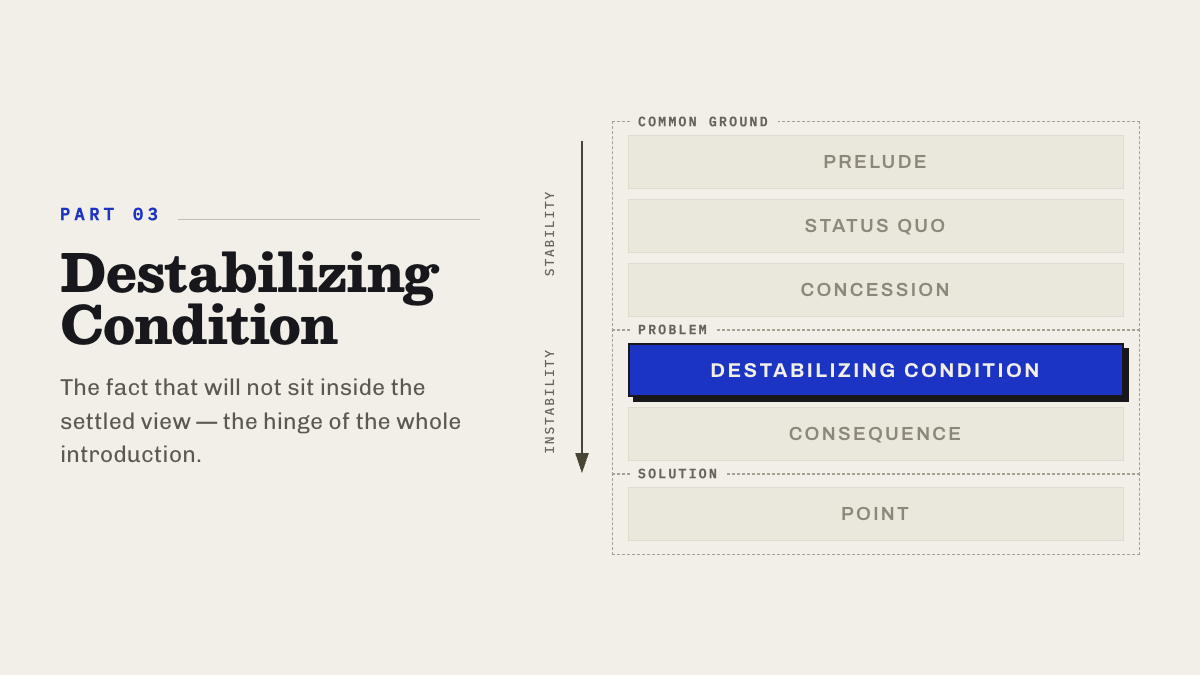
Now the turn.