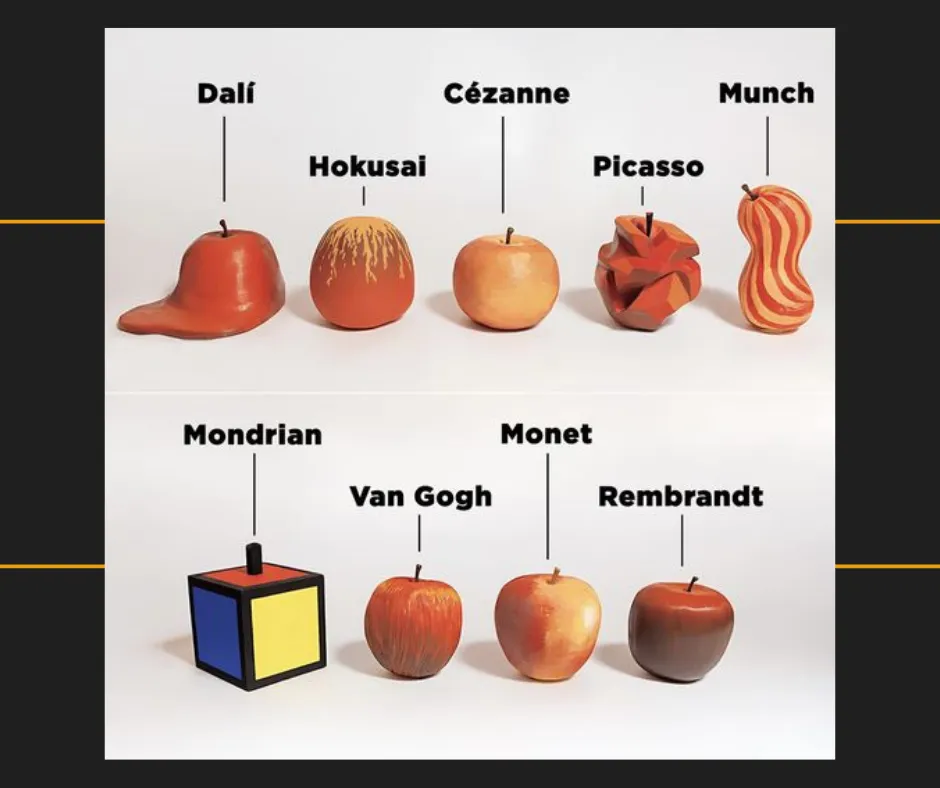
Two painters can look at the same bowl of fruit and construe it differently.
Rembrandt renders every grape with precision and clarity. Picasso fragments the same scene into abstract planes and shapes. Both are looking at the slice of reality. But the choices they make about how to represent it change everything about what the viewer experiences.
Writers face the same choice with every sentence.
The actions in your story—what characters do—can be represented with precision, or they can be fragmented into abstractions. And this choice determines whether readers see a clear story or a fog of vague concepts.
What It Is
Every story is about someone doing something.
In the last tool, we put the "someone" in the subject position. Now we need to put the "doing something" where readers expect to find it: in the verb.
This sounds obvious, but writers constantly move their key actions out of verbs and into nouns. When that happens, the real verbs in the sentence get replaced by vague, empty placeholders.
Compare:
A climb up the beanstalk was undertaken on the part of Jack, when the giant's discovery of him took place, resulting in his fright.
Jack climbed the beanstalk when the giant discovered him and frightened him.
| Clause | Subject | Verb | Object | Adjunct |
|---|---|---|---|---|
| S1 main | A climb up the beanstalk | was undertaken | — | on the part of Jack |
| ↳ when | the giant's discovery of him | took place | — | — |
| ↳ resulting | — | resulting | — | in his fright |
| S2 main | Jack | climbed | the beanstalk | — |
| ↳ when | the giant | discovered | him | — |
| ↳ and | (the giant) | frightened | him | — |
The key actions are climbing, discovering, and frightening.
In the first version, these actions have been converted into nouns:
- a climb,
- discovery,
- fright.
And because those nouns now occupy the slots where the verbs should be, the sentence has to fill in with weak, generic verbs:
- was undertaken,
- took place,
- resulting in.
In the second version, the actions sit in the verb position:
- climbed,
- discovered,
- frightened.
The second sentence tells a clear story.
Why It Works
Verbs are the beating heart of a sentence. They're what tell readers what's happening.
When you drain the action out of your verbs and pack it into nouns, two things go wrong.
First, the verbs become empty.
Words like "was undertaken," "took place," "occurred," "was made," and "resulted in" are verbal filler. They occupy the grammatical slot of a verb but convey no specific action. So readers recognize the verb position, expect to learn what happened, and get nothing.
Second, the sentence gets longer without getting clearer.
Turning actions into nouns requires extra grammatical scaffolding—prepositions, articles, helper verbs—that adds words without adding meaning.
We decided → a decision was made by us.
Four words become six, which adds extra cognitive load to your reader.
When you keep actions in verbs, readers find someone in the subject and what they're doing in the verb.
That's the structure of a story, and it's the structure readers process most efficiently.
How to Use It
Let's say you start out with a sentence like this:
The implementation of the new system resulted in a significant improvement in the processing of customer orders.
Something's wrong here, but you're not sure what.
Step 1: Find the real actions.
Read your sentence and ask: What is actually happening here? What are the key events or actions? Underline them.
The implementation of the new system resulted in a significant improvement in the processing of customer orders.
Step 2: Check where they live.
| Subject | Verb | Object | Adjunct |
|---|---|---|---|
| The implementation of the new system | resulted | — | in a significant improvement in the processing of customer orders |
Are those actions expressed as verbs, or have they migrated into nouns?
Step 3: Rebuild the sentence with actions in verbs.
The real actions here are implementing, improving, and processing.
Let's rebuild the sentence so that those actions are carried by the verb:
| Clause | Subject | Verb | Object | Adjunct |
|---|---|---|---|---|
| Before | The implementation of the new system | resulted | — | in a significant improvement in the processing of customer orders |
| After | we | processed | customer orders | significantly faster |
| ↳ when | we | implemented | the new system | — |
Step 4: Watch for the telltale signs.
If your sentence contains verbs like these, you've probably buried your real actions somewhere else:
- is, was, are, were (be-verbs)
- made, conducted, performed
- took place, occurred, happened
- resulted in, led to, gave rise to
These are placeholders. The action is hiding in a nearby noun. Find it, turn it back into a verb, and the sentence will be much more clear.