Most writers think their job is to deliver good ideas.
It isn't.
Like the proverbial tree falling in the forest, if your idea lands in the wrong place, no one will understand it.
In this week's issue of Writer Science...
- a Costco story that explains why your readers keep getting lost
- nine practical tools to fix it,
- and a method for using writing to generate valuable ideas (instead of just recording what you already know).
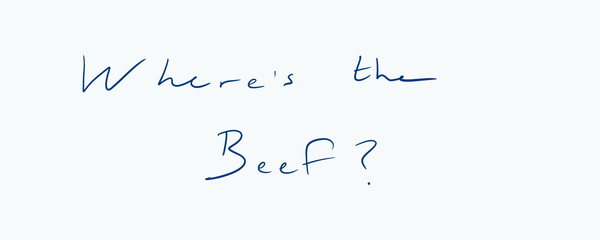
🥩 Where's the Beef?: Giving Your Readers What They Need, Where They Need It

My Costco system is pretty tight.
In and out in 30 minutes, flat. Podcast in my earphones, pushing the cart like a lawnmower, better not get in my way.
Locked in my sights is the ground beef. A big slab lasts me 2–3 weeks of lunches. I get it every time, and it’s always in the same spot.
Except yesterday. It wasn’t there. 🤨
I stalked every cooler in that store. Beef section. Chicken section. I even checked near the sushi. Nothing.
Eventually I had to flag down a clerk, who led me around a corner to some hidden cooler I’d walked past a dozen times.
He didn’t look particularly enthused to be leading me around. And I get it—he’d put out what I wanted. Couldn’t I just find it myself?
But giving someone what they want isn’t enough. You have to put it where they expect to find it.
This is the mistake most writers make.
They package their ideas in a way that makes sense to them, then hand it off to readers and let them figure it out.
But readers don’t come to your text as a blank slate, willing to wander through its aisles like they're in an art gallery.
They come with fixed expectations—not just about what information they’ll find, but where within the structure of your text they expect to find it.
Ignore those structural expectations, and you’re the clerk who hid the ground beef in a cooler nobody knew existed.
The good news: there are practical, learnable writing tools that help you put your ideas exactly where readers are looking for them.
I’ve been collecting those tools into a library of writing tools.
There are nine up now, but I'll be adding more as I discover them. Totally free. You can start using them today.
✍️ Interesting Ideas, Useful Tools
- How to Write a Film Review ▶︎ Great cultural criticism doesn't ask "is it good?" It asks "why did this take hold?" I wrote about "The Unreal Thing" by Adam Gopnik, an essay that doesn't review The Matrix so much as excavate it, tracing an ancient anxiety through centuries of philosophy to explain how the film became a cultural touchstone. It's a great example of what ambitious nonfiction writing can do, and I can't wait to hear what you think of it over on Essay Club.
- The Coffee Stain Problem ▶︎ You can't edit your own writing. Not really. Whenever you reread your words, your brain isn't actually reading. It's remembering. George Gopen explains why revision is harder than most writing advice admits.
- Spotlight Your Main Characters ▶︎ Every sentence tells a story. And one of the first questions your reader asks is, Who/what is this story about? This writing tool will show you how to answer that question clearly every time.
💬 Think on Paper

The top 1% of experts don't treat writing as an afterthought; they use writing as an extension of their thinking.
If your expertise is valuable, then it answers question and solves problems. And real problems are too complex to be worked out in your head. (If they were that simple, they wouldn't be problems.)
So you can't think first, write second.
You need to use writing to do your thinking.
Here's how:
- Adopt the "Write to Think" Method: Instead of aiming for a polished draft immediately, use your first writing session to generate ideas.
Set a timer, open a blank document, and do a "brain dump" to solve problems through writing, not just record what you already know. - Use a Reverse Outline: After completing your first draft, don't edit for style—yet. Instead, go back section by section and write a label describing exactly what each part does.
If you cant label it, it's probably fluff or disorganized. - Rebuild for the Reader: The path you took to understand an idea is likely not the best path for your reader.
Use the labels from your reverse outline to restructure the document, starting from the reader's current knowledge and guiding them to the new understanding. - Hunt for Community-Specific Code Words: Identify your specific target audience and research the language they use (e.g., technical terms, jargon, or values).
Replace generic language with these "code words" to immediately signal that you understand their world and speak their language.
For the full tutorial, check out The Top 1% of Experts Think on Paper—Here's How
🌟 Editor's Choice
PS-Enjoy this newsletter? Forward it to a friend, drop a comment, or hit reply to share your thoughts. I'd love to hear from you!
Work with Me: Get feedback on your writing and actionable advice through a 1:1 consultation with me – apply here