If you're an expert, you're not struggling for things to say.
You've done the work, developed your opinions, and you know the landscape of your field better than most.
The struggle is in getting readers to actually receive what you're saying.
Most writers think the problem here is to be found in the text itself. They try to improve their writing at the formal level—tweaking word choice, sentence structure, formatting.
Or they think it's with the ideas. So they borrow tools from storytelling, establish their credentials, practice copywriting to move readers from where they are to where the writer wants them to be.
But the problem is not in the text. It's not your argument, credentials, or writing style.
The problem, it turns out, is structural. And that structure, according to George Gopen, is almost invisible to the person doing the writing. But it's all your reader sees.
Gopen, director of the writing program at Duke University and author of Expectations: Teaching Writing from the Reader's Perspective (2004), argues that readers don't passively receive meaning. They actively construct it, based on expectations about where information should appear in a sentence or passage.
So no matter how valuable your ideas are, if your content lands in the wrong structural position, it will be misread.
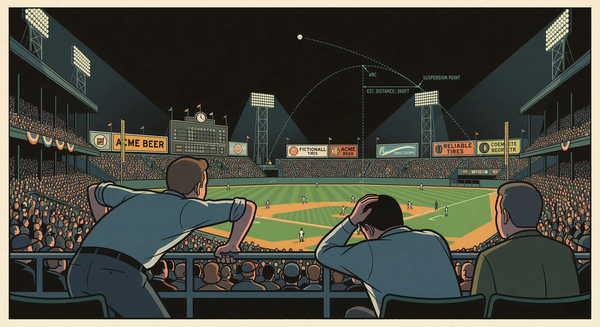
To illustrate how expectations shape interpretation, Gopen turns to baseball.
He asks us to imagine the final inning of a Red Sox–Yankees game.
In the audience are three persons of interest:
- a Red Sox fan,
- a Yankees fan,
- and someone who doesn't give a toss about baseball.
In the stands are three people of interest to us: a rabid Red Sox fan, scarred by decades of late-season team collapses; an equally rabid Yankees fan, essentially hubristic and condescending, but with traces of mistrust and self-doubt; and an Unwilling Participant, trapped by social needs into attending the game, uncaring of the outcome, and thoroughly bored.
The bases are loaded, two outs, a two-run lead. The batter hits a high fly ball to center field. The center fielder settles under it.
What happens next?
Gopen points out that the same fly ball produces radically different experiences, depending on who's watching:
... a single act produces widely varying interpretations because of the different contexts in which it is perceived. The interpretation of the ninth-inning fly ball is infinite in its possibilities because the potential number of different and differing perceivers is infinite. Without question, the play will be described in distinctly different terms by (a) the Red Sox radio broadcaster, (b) the Yankees radio broadcaster, and (c) the national network (presumably nonpartisan) television broadcaster.
The ball doesn't change. The stadium doesn't change. But interpretation changes, because context changes.
For the Red Sox fan, a clean catch is vindication.
For the Yankees fan, it's defeat.
For the Unwilling Participant who knows nothing about baseball, the arc of the ball against the night sky "might raise no expectations whatever; no context would be naturally constructed within which interpretive possibilities would be suggested."
What does the fly ball mean? Depends who you ask.
The same interpretive event gives rise to three entirely different experiences of meaning.
The implications for writing are direct. Gopen draws the analogy explicitly:
Every act of discourse — small or large — is just such a fly ball. If we want our particular audience to interpret our particular discourse act in a specific way, we must control the context so that it will position the greatest possible percentage of readers to be transformed into knowledgeable fans on our side.
This reframes the writer's job entirely.
You're not a transmitter broadcasting a signal. You're a stadium manager—responsible for positioning your reader so they experience what you intend them to experience.
If the reader is confused, it's not because they're slow. It's because they're working through your text from a context that gives them a set of expectations—expectations about what kind of information they expect to find, and the structural locations where they expect to find it. So if the reader is confused, it's because the text failed to meet their expectations.
When your text fails, the problem isn't that readers didn't try hard enough. It's that you handed them a fly ball without telling them which team they're rooting for.
But what does "controlling context" actually look like in practice?
For Gopen, it comes down to structural placement.
Readers, he argues, lean into prose the same way a baseball fan leans into a fly ball—with a felt sense of where things are headed and when they should arrive:
We lean into the structure of prose much in the same way the baseball fan leans into perceiving the parabolic descent of the fly ball. We read from left to right and through time. As we proceed, we expect certain kinds of substance to appear at certain structural moments.
When we consider the phenomenology of reading—how it unfolds in the experience of the reader—we can already start to see the expectations a reader brings to the text.
We don't like it, for example, when new information arrives out of nowhere; we learn new information most easily when it's embedded in familiar context. For that reason, readers expect the information in your sentence to be organized from old to new.
For another, every sentence tells a story, which is about someone doing something. But actions aren't just out there in the world happening; there are agents performing those actions. For that reason, readers expect to see the someone doing the action in the subject position, and the action that's happening in the verb position.
When information arrives where it's expected, reading feels effortless.
When it doesn't, the reader experiences a kind of dropped ball—a disruption that forces them to recalibrate, upsetting a previous set of expectations and setting up a new one, which may or may not align with the reader's interests.
The practical takeaway isn't to write more carefully. It's to bring your attention away from the formal, surface-level aspects of your writing, and to highlight the structure.
To see this writing advice in practice, check out our list of Writing Tools.