Should we save dying languages?
Probably not.
Hot take, I know. But of this I was thoroughly convinced by John McWhorter's The Language Hoax.
Whenever people say that we should save dying languages, they always appeal to some version of the claim that this book debunks. They say:
'A language is not just a set of words and grammar; it's a worldview, a unique set of glasses that construes that world in a way that cannot be perceived by those who don't speak the language. When we lose a language, we lose a unique way of seeing the world.'
For example, here's Wade Davis, the Canadian ethno-botanist and former explorer-in-residence for National Geographic:
A language is a flash of the human spirit. It’s a vehicle through which the soul of each particular culture comes into the material world. Every language is an old-growth forest of the mind, a watershed, a thought, an ecosystem of spiritual possibilities.
The idea here—that language determines worldview—was passed down to us a century ago by Benjamin Lee Whorf. No linguist, Whorf was a firefighter who was quite taken by the Hopi language. He noticed that in the Hopi language, time is construed not as a line, as it is in English (a long time), but as a ring. (He was wrong about this, but that's beside our point.) Whorf concluded (also incorrectly, and more to our point) that this must mean that the Hopi perceive time as a circle, never ending or beginning but in a constant cycle.
To learn Hopi, according to Whorf, is not merely to translate ideas from one language to another; it's to step out of a world in which time proceeds on a horizontal axis and to perceive the world afresh.A compelling idea. It's one that I used to invoke whenever I taught EFL in South Korea, inspiring students to look beyond their exams to all the second-order benefits they'd gain from seeing the world from a new perspective. And it's one that is still marshalled to support the claim that some fidelity is always lost in translation.
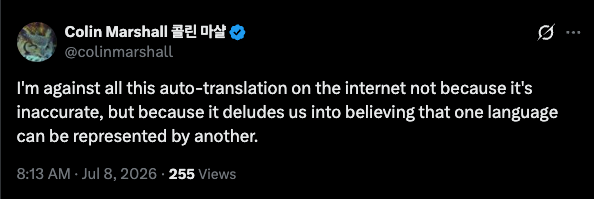
Unfortunately, it's just not true.
There's no evidence to support it. And even if there were, the idea that language determines your worldview carries with it a set of implications that would be hard for the kinds of people who argue for linguistic preservation to endorse.Let's start with the evidence.
Setting aside anecdotal reports of how bilingual individuals 'feel' when they speak one language versus another, what would count as evidence for Whorf's strong claim?

We could compare different grammar systems, and use those differences to predict different worldviews.
Some languages, for example, encode the source of information with evidential markers. If Whorf is right, we would expect speakers of these languages to be more attentive to the source of information—which is to say, more skeptical—than others.
Languages featuring evidential markers tend to cluster in the Amazon basin. In these Amazonian languages, evidential markers are baked into the grammar—you can't say 'it's raining'; you'd have to say 'It's raining-I see' or 'It's raining-I heard.'
That's a lot of extra syllables devoted to providence, far more than we find in Romance languages like English, French, and German. But if it's true that speakers of Amazonian languages are more attentive than Europeans to the source of information—which is to say, more skeptical—then we might ask why the Enlightenment was born in Paris and London, and not Manaus and Iquitos.

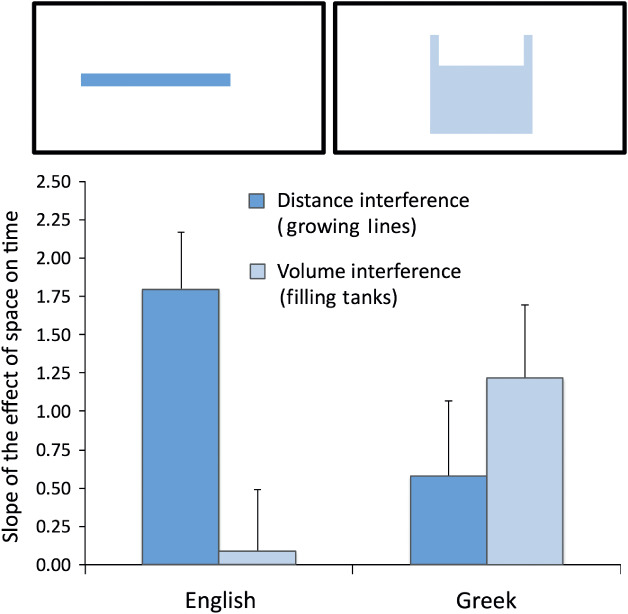
To be fair, there is some cognitive research to support a weaker version of Whorf's claim. For example, speakers of Spanish and Greek (which construes time in terms of quantity: mucho tiempo) are worse at anticipating the completion of a timed task when duration is represented horizontally than speakers of English (which construes time in terms of length: long time).
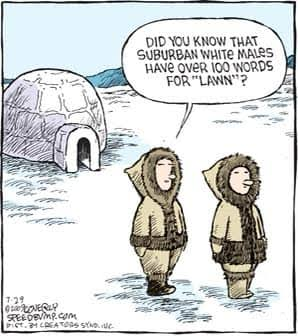
Likewise, you wouldn't be surprised to find that speakers of Inuit languages—which famously distinguish among several dozen types of snow—would be quicker at perceiving the distinctions than speakers of other languages. But is that because of the language, or is it because they live among the snow? Is a Spanish speaker unable to conceive of time in terms of length, or are they just more accustomed to thinking of it as a quantity?
It's a far stretch to say that these distinctions entail different worldviews. Spanish is not a set of glasses that upends our perception of time, nor is Eskaleut the only medium in which speakers of English could conceive the differences among snow. (Note that we've been perfectly able thus far to communicate these distinctions in plain old English.)
It seems more plausible to say that language is the downstream reflection of worldview, not its upstream cause.
But even if the linguistic preservationists, well meaning as they are, could back up their claims, they would shudder to realize what they entail. If you think that language determines your worldview, you'd have to think that speakers of simpler languages have simpler worldviews. The Chinese language, for example, is known as a telepathic language for all the distinctions it omits, leaving much up to context that would need to be spelled out explicitly in English. Take for example the following sentence, a complex conditional offered by McWhorter:
If you saw my sister you would have known that she is pregnant.
Rendered in Chinese, which leaves much of the grammatical nuance up to context, it reads:
If you see my sister, you then will know she pregnant.
The conditional construction in English carries a lot of grammatical information that is lost in translation. Does this mean that speakers of Chinese are unable to perceive the finer distinctions observed by English speakers? If Whorf is right, then you'd have to say that speakers of simpler languages like Chinese perceive less nuance in the world—which is to say, they're a little dull. You could make a similar case for ebonics, if you were so motivated. But something tells me the linguistic preservationists wouldn't go this far.
Language is, in the end, not a medium of thought; it's simply a medium of communication. And that's a good thing.
The best language is the one that everyone speaks.