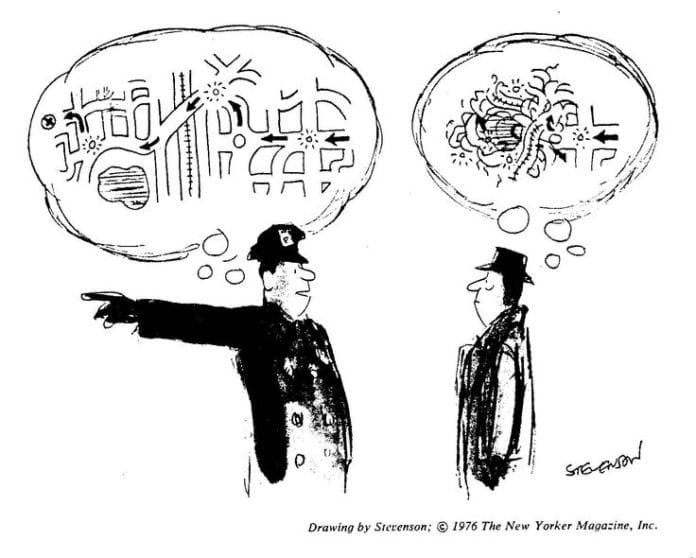
Can you edit your own writing?
Many writing instructors say yes. You just need to give it some time so that you can look at it with a reader's eyes.
And there's a reason they tell you to put a draft away for a week before revising it. Sleep on it. Get distance. Come back with fresh eyes.
But they never explain why.
This means writers follow the rule without really understanding what they're guarding against.
George D. Gopen, whose work on reader-focused writing has shaped how composition is taught in research universities across the country, has a precise diagnosis for the problem.
In his book, Expectations: Teaching Writing from the Reader's Perspective (2004), Gopen explains why editing your own prose is one of the most difficult intellectual tasks there is, all due to a trick that your mind plays on you. He refers to this trick as The Coffee Stain Problem.
It starts with what you think is happening when you reread a sentence you've written:
You see the words. You know the meaning of each of these words. When you put these words with those meanings into this syntactical structure, the meaning of the whole is X. Since X is what you intended to convey, you judge the sentence to be fine.
That's the illusion. What's actually happening is something far more modest:
You see the words. You remember those words. Those are the words you summoned when you were trying to articulate X.
This latter type of reading, according to Gopen, isn't read it all but "mere association."
You chose those words while trying to express a particular idea. So naturally, when you encounter them again, they remind you of that idea.
But this private reminder is not communication. The question, as he puts it, is "whether those words will communicate X to most of your readers."
Gopen drives this point home with a helpful example:
You are at the breakfast table one day, looking over last night's writing. Suddenly you are struck by a scathingly brilliant idea. In your haste to record it, you overturn your coffee cup. The coffee spills and stains the corner of your page.
From that moment forward, Gopen argues, that coffee stain "might recall for you, through mere association, that scathingly brilliant idea." But no future reader of that page is going to get it from the stain.
This is what he calls the coffee stain problem: if our own associations are baked into every word we've chosen, how do we ever get enough distance to evaluate whether those words will work for a reader who doesn't share our associations?
Gopen's answer is structural.
Rather than trying to re-read your document as a stranger (which you can't quite do), you learn to check your prose for something more objective: the location of information.
Readers have deeply ingrained expectations about where important material will appear in a sentence. They expect to find action in the verb position, characters in the subject, and important, emphasis-worthy information at the end of the sentence.
And when substance lands somewhere other than where readers expect to find it, comprehension suffers.
So by auditing structure rather than meaning, you sidestep the association trap. As you re-read your work, you're not asking "does this convey my idea?" (a question your memory will always answer in the affirmative) but rather "is the key information located where the reader expects to find it?"
What makes this approach powerful is the feedback loop it creates.
Fix the structure, and Gopen says you'll find yourself pulled back into the thinking itself: "we will discover what it was we really had been trying to say."
Revision, done right, is an extension of the thinking process.
If you've ever sent a message, gotten back a confused response, and thought but it was so clear, remember Gopen's coffee stain problem. You weren't reading your writing. You were remembering it.