Table of contents
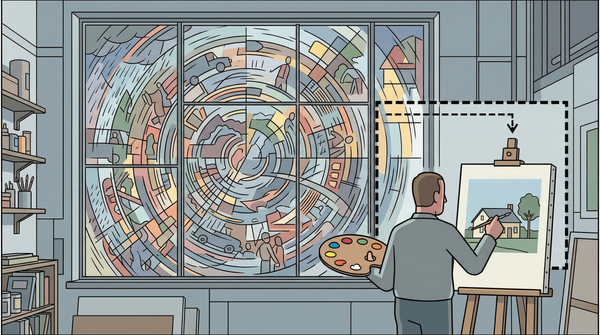
Experience doesn't arrive in sentences. It arrives as a continuous flow of events—an undifferentiated cascade of processes.
An event occurs, a feeling arises, a fact settles into place. The world presses in from all directions at once.
But the moment you commit to a sentence, you stop the flow. You carve a chunk out of it, give it a shape, representing this quantum of change as a particular kind of process: something happening, something being felt, something simply existing.
Every sentence is a claim about what kind of process this unit of experience is.
This most fundamental decision in writing is, for many writers, made by default.
This most fundamental decision in writing—how to model a unit of experience as a process—is, for many writers, made by default. They reach for whichever words come first, unaware that language offers six distinct ways of rendering experience—six colors on a palette, each one capable of capturing something essential about experience that the others miss.
When a passage feels flat or airless or somehow wrong, it's often because the writer has reached for the same color repeatedly, or chosen a shade that doesn't match the process the experience calls for.
The System of Transitivity
These six colors are mapped by the grammatical system of transitivity. And the map, once learned, makes this unconscious choice a deliberate one.
This system and its six writing tools comes from M.A.K. Halliday's An Introduction to Functional Grammar—a foundational text in linguistics, and one of the most useful guides to communication that most writers have never heard of.
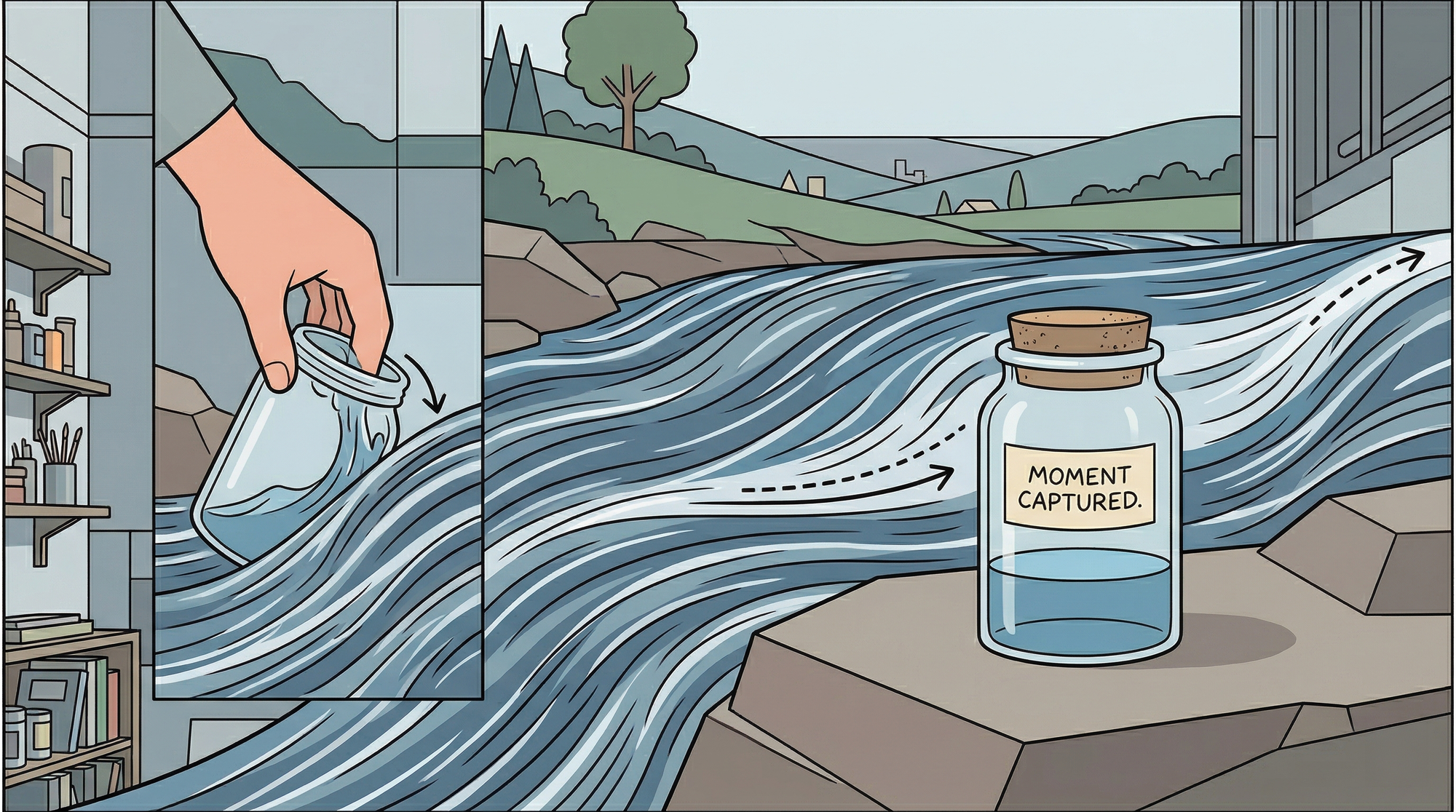
Our most powerful impression of experience, Halliday writes, is that it consists of "a flow of events, or 'goings-on.'" Yet language cannot reproduce that flow. It can only organize it:
The flow of events is chunked into quanta of change by the grammar of the clause: each quantum of change is modelled as a figure—a figure of happening, doing, sensing, saying, being, or having. All figures consist of a process unfolding through time and of participants being directly involved in the process in some way.
The grammatical system that governs this chunking is that of transitivity.
Put simply, the system of transitivity describes the relationship between a process and its participants—who does what to whom, and what kind of doing it is. Every clause enacts this relationship, whether the writer is aware of it or not.
In Systemic Functional Linguistics, the approach to grammar founded by Halliday, grammar is not an abstract formal system. Instead, it's a resource that evolved to reflect human experience. The transitivity system, in this view, is nothing less than a map of how human beings experience the world. As Halliday puts it:
The system of TRANSITIVITY provides the lexicogrammatical resources for construing a quantum of change in the flow of events as a figure — as a configuration of elements centered on a process.
The kinds of process available in that system, like the colors on a painter's palette, reflect the fundamental structure of human experience itself.
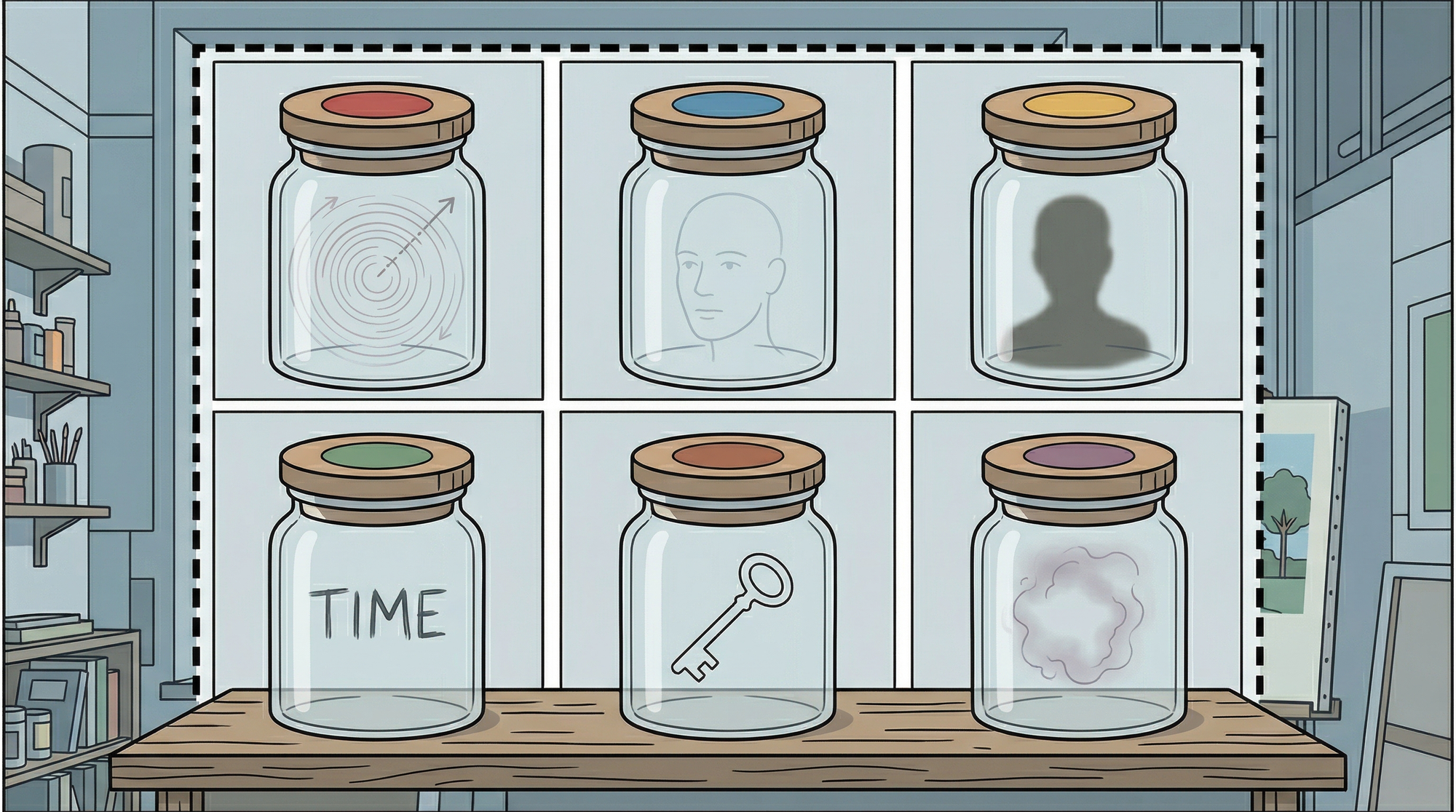
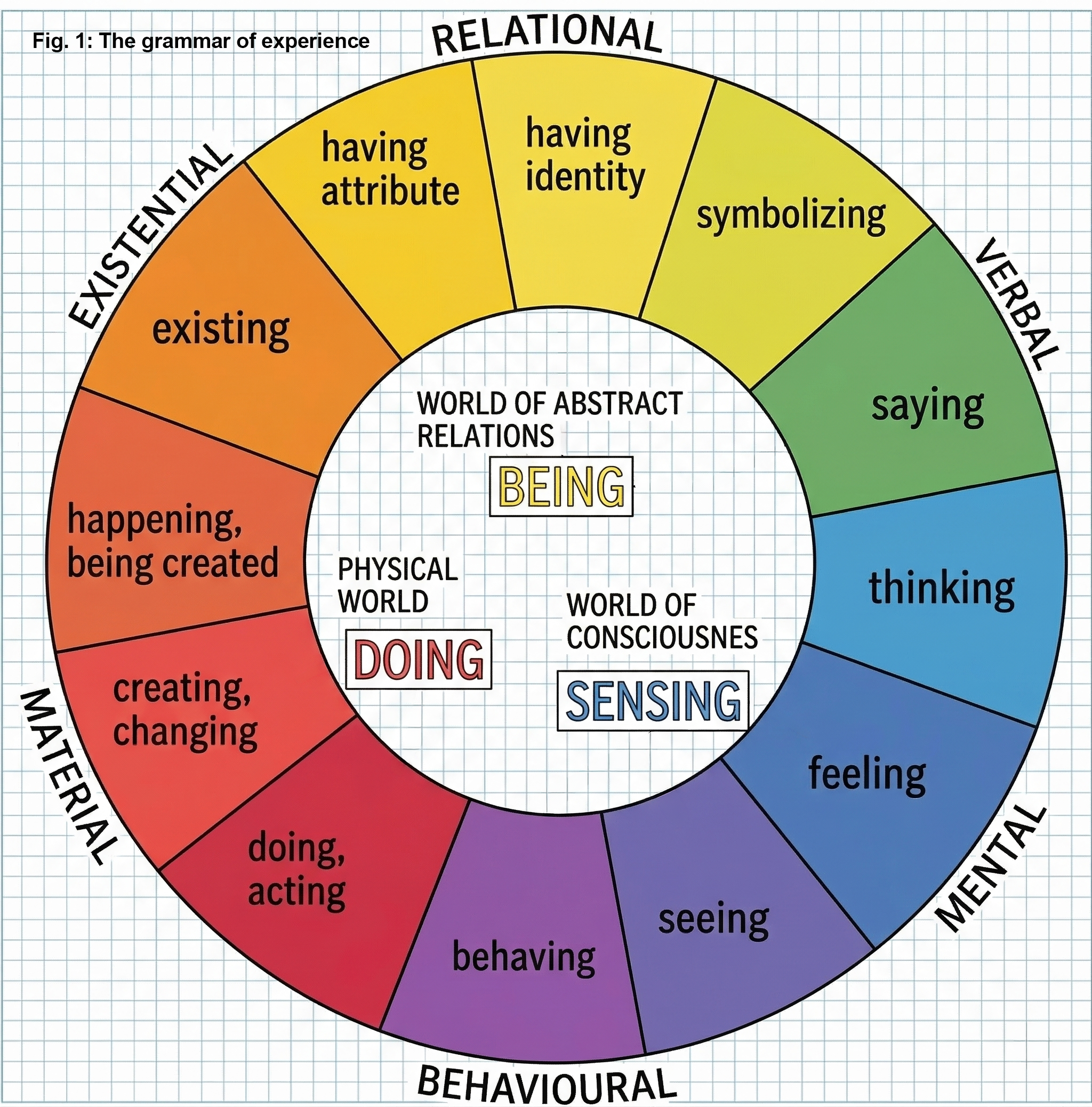
At the base are three primary domains of experience.
But where those regions blur into one another, the grammar follows, producing three further process types at the borders.
The three primary process types are rooted, Halliday argues, in distinctions we learn to make before we can speak. There is, he writes,
a basic difference, that we become aware of at a very early age (three to four months), between inner and outer experience: between what we experience as going on 'out there,' in the world around us, and what we experience as going on inside ourselves, in the world of consciousness — including perception, emotion, and imagination.
But outer and inner alone are not enough to account for the full range of human experience. A third component is required:
We learn to generalize — to relate one fragment of experience to another in some kind of taxonomic relationship: this is the same as that, this is a kind of the other.
These three foundations—outer experience, inner experience, and the generalizing impulse—are the bedrock of the transitivity system.
But in the grammar, as in experience itself, their edges don't hold cleanly. Where the three primary regions blur into one another, the grammar follows, producing three further process types at the borders. As Halliday observes:
Material, mental, and relational are the main types of process in the English transitivity system. But we also find further categories located at the three boundaries; not so clearly set apart, but nevertheless recognizable in the grammar as intermediate between the different pairs — sharing some features of each, and thus acquiring a character of their own.
The Six Processes
1. The Event (material process)
The first and most common process type is also the most elemental: something happens, or someone does something. Halliday calls these material process clauses, and locates them in what he describes as "outer experience"—the processes of the external world.
The prototypical form of this outer experience, he writes, is
actions and events: things happen, and people or other actors do things, or make them happen.
Nigeria fell to the British. The machine sorted the money. I had a shower.
These are sentences in motion. They enact and advance rather than assert or describe.
When writing teachers tell you to use action verbs, this is what they mean—not a stylistic preference, but a process type. The instruction to show rather than tell is, at the grammatical level, an instruction to reach for material process clauses.
They are the workhorse of narrative, and the primary resource a writer has for making experience feel real rather than reported.
2. The State (relational process)
Where material processes put the world in motion, relational processes hold it still and name it.
These clauses identify, classify, and characterize. They construe what Halliday calls "generalizing experience," the human tendency to relate one fragment of experience to another:
This is the same as that, this is a kind of the other. Here the grammar recognizes processes of a third type, those of identifying and classifying.
Every fourth African is a Nigerian. The three major groups are the Yoruba, the Ibo, and the Hausa.
These are the clauses of definition, argument, and taxonomy. They comprise the grammar of the essay, the lecture, the analysis. Without them, a writer cannot make a claim or draw a conclusion.
But as David Abram points out in The Spell of the Sensuous, relational clauses carry a risk.
All abstraction, according to Abram, is built upward from sensory, bodily experience. Concepts only mean something because they are grounded, however distantly, in the felt experience of the world.
So a relational clause that arrives without that grounding— one that classifies before the reader has experienced what is being classified—asks the reader to accept a conclusion they haven't yet earned. The category floats free of the experience that would make it real.
This is the grammar of bad academic prose. Not wrong, exactly. But baseless. A structure of definitions resting on nothing the reader has been made to feel.
3. The Inner Life (mental process)
Between the outer world of events and the relational world of classification sits the inner world of consciousness.
Mental process clauses construe what Halliday calls the experience "going on inside ourselves":
The 'inner' experience is harder to sort out; but it is partly a kind of replay of the outer, recording it, reacting to it, reflecting on it, and partly a separate awareness of our states of being.
The Ibos did not approve of kings. I was fascinated by it. People love money.
What distinguishes these clauses grammatically is that they require a conscious participant—a Senser, in Halliday's terminology—someone for whom the mental event is occurring.
This is the grammar of interiority, of the mind pressed against experience.
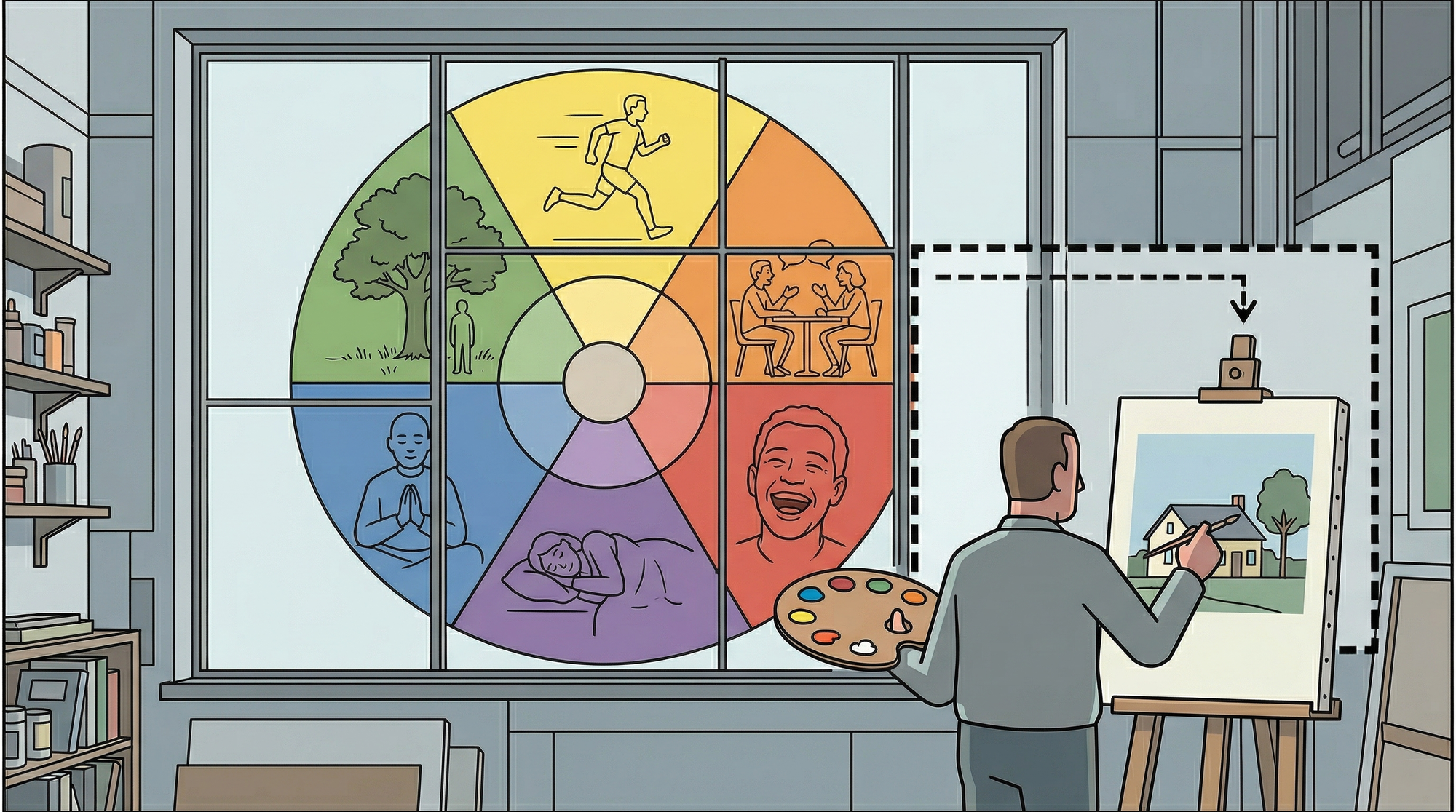
4. The Speech Act (verbal process)
On the border between mental and relational processes live the verbal clauses. These construe, as Halliday puts it,
symbolic relationships constructed in human consciousness and enacted in the form of language, like saying and meaning.
We say. Can you tell us. The data suggest.
Verbal processes are indispensable to nonfiction writers. These are the sentences that bring other voices into the room. They introduce claims, cite authorities, stage debates. They are how ideas enter with a human face attached.
The risk they carry is pure attribution: endless verbal clauses with no actual claim being made, a procession of researchers argue and scholars suggest that never arrives anywhere.
5. The Body (behavioral process)
On the border between material and mental processes are what Halliday calls behavioral clauses—those that represent
the outer manifestations of inner workings, the acting out of processes of consciousness and physiological states.
People are laughing. They were sleeping. She stared.
These are not quite events and not quite states of consciousness. They are the place where the two meet—where interiority becomes visible in the physical world.
Often the most precise characterization available to a writer lives here. The body as evidence of the mind, action as the residue of feeling.
A vast resource for those who wish to show, not tell.
6. The Existence (existential process)
At the border between relational and material processes sit the existential clauses—those by which, as Halliday puts it, "phenomena of all kinds are simply recognized to 'be' — to exist, or to happen":
Existential clauses are unique in that the Subject is not a participant but rather the item there, which represents only 'existence', not the participant that exists; this participant comes after the Process.
There's Christianity in the south. There was a man called Noah.
These are the establishing shots of prose, the conjuring moves that summon something into being before the action starts.
The risk in these process types is passivity. A writer can keep announcing the existence of things without ever doing anything with them.
Painter's Palette, Writer's Wheel
Halliday insists that these six process types form a circle, not a list. The color wheel metaphor is his own:
The grammar construes experience like a color chart, with red, blue and yellow as primary colors and purple, green, and orange along the borders; not like a physical spectrum, with red at one end and violet at the other.
The borders between process types are, Halliday argues, a fundamental feature of how language works.
Experience itself doesn't come pre-sorted: we perceive, as David Abram points out in The Spell of the Sensuous, through all the senses simultaneously.
For Halliday, this mode of perception is called systemic indeterminacy: the grammar's honest acknowledgment that reality resists clean edges.
Emotion, for instance, can be rendered as a mental process (this pleased God), a relational quality (God was sad), or a behavioral one (God wept). These are not synonyms; each model renders something the others cannot. And the choice between them shapes the reader's experience.
This is where the palette metaphor earns its keep.
A painter who reaches for the same color repeatedly doesn't produce a painting so much as a monochrome.
The same is true of prose.
A passage built entirely from relational clauses—definitions stacked on classifications—has a particular kind of lifelessness: correct, perhaps, but inert, modeling reality as a static encyclopedia entry.
A narrative that never leaves the material world is kinetic but thin, all event and no interiority.
The most vivid writing tends to move across the wheel—not because the writer has followed a rule, but because the experience demanded it.
The borders of the wheel are where the most resonant sentences tend to live.
A material clause whose content is psychological—e.g., the city devoured him—creates friction between the model and the experience, and that friction is where the metaphor ignites.
A relational clause that conjures rather than classifies— grief is a room you can't leave — does something that neither image nor statement could do alone.
These aren't grammatical accidents; they are the writer pressing against the edges of a process type, finding the expressive potential that lives there.
Which is perhaps the most useful thing the transitivity system offers a writer: not a taxonomy to apply, but a question to carry into revision.
When a passage feels wrong—flat, airless, somehow off—it's worth asking not just what words am I using but what process am I modeling. By changing the process type, you change everything about the figure: the happening and its participants.
The flow of experience is continuous and indiscriminate. Every sentence is a decision about how to stop it, shape it, and hand it to a reader.
The transitivity system won't make that decision for you. But learning about the system makes the writer aware that one is being made.