She smelled the way the Taj Mahal looks by moonlight.
That famous line from Raymond Chandler seems to make a category error. Smelled the way something looks? That's not how senses work. Smell and sight arrive through different sense doors, trigger different nerves, and activate different regions of the brain.
And yet it works.
The conflation of one sense with another, synesthesia, touches on something both weird and weirdly familiar.

In The Spell of the Sensuous (1996)—a work of philosophy and ecology that has become something of a cult classic—David Abram explains why the senses are not separate channels, but are in fact one unified, bodily encounter with the world.
His observation runs counter to a familiar piece of writing advice, which tells writers to use all five senses.
While it might sound like practical writing advice, in practice it conjures an image of writers working through a checklist—What did the character see? What did they hear? What did they smell?
The problem is that this approach, however well-intentioned, is built on a false picture of how perception works. It treats the senses as five separate input channels, each feeding its own data stream into the brain, which then assembles a complete picture of the world.
But that's not how experience actually feels from the inside. Here is Abram:
If I attend closely to my nonverbal experience of the shifting landscape that surrounds me, I must acknowledge that the so-called separate senses are thoroughly blended with one another, and it is only after the fact that I am able to step back and isolate the specific contribution of my eyes, my ears, and my skin.
The separation into sensations comes after the experience, according to Abram. It's something we do to an experience once it's already happened. To describe a sound, a sight, a feeling, is to perform an act of intellectual sorting.
The experience arrives whole. The intellect sorts it out.
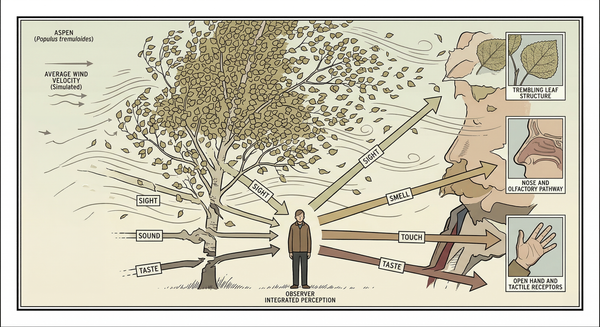
A skilled, lyrical writer, Abram grounds his argument in a concrete moment that the reader can easily recognize—standing outside, watching wind move through the branches of a tree:
When I perceive the wind surging through the branches of an aspen tree, I am unable, at first, to distinguish the sight of those trembling leaves from their delicate whispering. My muscles, too, feel the torsion as those branches bend, every so slightly, in the surge, and this imbues the encounter with a certain tactile tension. The encounter is influenced, as well, by the fresh smell of the autumn wind, and even by the taste of an apple that still lingers on my tongue.
The passage rewards a careful rereading.
The sight of the trembling leaves and the sound of their whispering are not two separate quanta of experience. They are unified in a single clause: the writer is "unable, at first, to distinguish" the "trembling" sight from their "whispering" sound; that distinction comes after.
Abram uses the resources of grammar to illustrate its point. Other writers who consider experience a braid of the five senses might mirror this phenomenology with a kind of checklist: sound, sight, smell, etc. But Abram writes about the experience as more of a unified texture, mirroring in grammar how it actually feels to be present in that moment.
Yet as Abram admits, the moment he tries to describe those blended senses, something is lost. In pulling them apart to name them, he severs the very thing he meant convey: what Merleau-Ponty calls the
primary layer of sense experience that precedes its division among the separate senses.
This is the writer's central problem: Language is linear, abstract, and sequential. The reader always encounters the subject before the verb. Yet experience is simultaneous and fused. Every time you write about experience, you are imposing a sequence on something that arrived all at once.
So when you set out to write about this experience, the question is whether your words carry the texture of fused experience, or whether they just inventory its parts.
Passages like Chandlers are described by modern psychology as synesthesia, a clinical diagnosis for people who see sounds or hear colors.
But Merleau-Ponty, as Abram reports him, argues that synesthetic perception isn't rare at all. It's the foundation of all experience. We've just been trained out of noticing it.
Synesthetic perception is the rule, and we are unaware of it only because scientific knowledge shifts the center of gravity of experience, so that we have unlearned how to see, hear, and generally speaking, feel, in order to deduce, from our bodily organization and the world as the physicist conceives it, what we are to see, hear, and feel.
We've been taught to experience the senses as separate, according to Merleau-Ponty, by the scientific dispensation. Science breaks the world into measurable parts and trains us to deduce experience from those parts, rather than trust the fused, whole thing that actually arrives.
This methodology is reflected in the five-senses checklist. It's the aesthetic analogue of that analytical habit of mind.
Which brings us back to she smelled the way the Taj Mahal looks by moonlight.
Chandler isn't making a category error. He's refusing to make the category mistake his readers have been conditioned to expect. He's not separating out the woman's smell and handing it to you in its own lane. He's giving you the texture of the encounter the way it actually arrived, as a unified quantum of experience.
The line feels strange because we've been trained to silo the senses.
But it works because it construes experience as it is, as a unified texture.