What's the purpose of writing?
Self-expression, according to one popular answer.
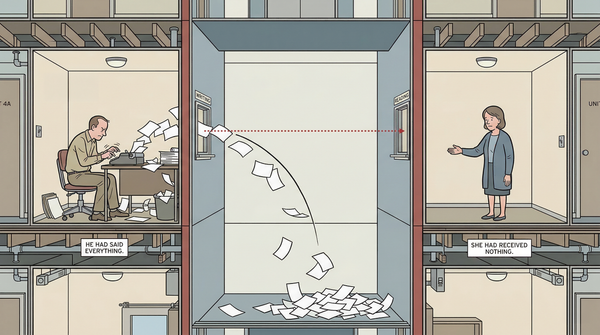
But if the purpose of writing is to express your thoughts, then a reasonable question to ask yourself before publishing is: have I said everything I wanted to say? With that criterion satisfied, we hit publish and send the text out to the world.
But a more helpful question to ask might be, Can the reader use this text?
And when we turn our attention away from the writer's self-expression and towards the reader's needs and expectations, we begin to rethink the purpose of writing.

One useful way to think about the real purpose of writing is provided by George D. Gopen, a professor of English at Duke University who spent decades teaching writing to scientists, lawyers, and executives.
In his practical book Expectations: Teaching Writing from the Reader's Perspective (2004), Gopen provides an illuminating illustration of where many writers misunderstand the purpose of writing, which he refers to as the Tollbooth Syndrome.
Here's the scenario he paints:
You are staying with friends in southwestern Connecticut and commuting by car into Manhattan at 5:30 A.M. to avoid the rush hour. On one particular day you have spent from 6:00 A.M. to 9:30 P.M. in the office with nothing to show for it. Everything that could go wrong did go wrong.
You're fighting rain, traffic, and exhaustion on the way home when you see the sign: Tollbooth, one mile, 40 cents, exact change, left lane.
You've got exactly three coins—a dime, a nickel, a quarter. You enter the exact change lane. The quarter drops in; the dime drops in; but the nickel hits the rim and bounces into the gravel.
It's been a long day already. So what do you do?
Do you step out into the rain and go rummaging around in the muck for a nickel?
Do you put your car in reverse, hoping the other cars behind you do the same, so you can switch lanes and explain to one of the toll booth operators your bad luck?
Or do you just go through the red light?
Though we understand it's wrong, many writers in practice go straight through the red light. And, as Gopen points out, we do so in good conscience.
But how do we convince ourselves that this is the right thing to do?
We don't think: I owe Connecticut 40 cents for road maintenance, and I haven't paid it. Instead, we justify the decision to drive through the red light by thinking: All that is required of me is to pay 40 cents—and that's exactly what I've done. After all, the money left your pocket, and that's what counts. Whether it actually landed in the pocket of the State of Connecticut—well, that's someone else's problem.
This is exactly what most writers do, according to Gopen:
Most writers do not care whether the intended audience actually receives their 40 cents' worth of communication; they care only that once they have digested all that work of thinking they now dispossess themselves of it onto the paper. That done, all is done.
You've done the work. You did the research, gained the experience, worked on the solutions. And then you wrote it all down. Done and dusted. So you ship it, fast. If readers don't know how to use your text—if they can't discern your argument, can't find the idea or understand the problem it solves—you can always point back to the gravel, where the idea is technically present, faintly gleaming under the grime.
This works fine in school, where teachers are paid to go looking for that nickel. A professor already knows the subject well enough to perform the act of interpretation for you—to take your scattered facts and signal words and reconstruct the thought you were trying to express.
But this school-based dynamic is artificial, and it bears no resemblance to the kind of communication that real readers expect:
Without an actual act of communication taking place, it naturally must be hard to teach students much about the act of communication.
But in real writing, no one is doing that interpretive work on your behalf. The reader's time is limited and their patience is thin. If the coins don't land in the basket, the highway doesn't get built.
Yes, your ideas are valuable. And yes, you made a sincere effort to write them out clearly. But all that value and sincerity amounts to nothing if they don't land where readers are expecting to find them.
Gopen's analogy asks us to reimagine the purpose of writing.
In school, we're taught that the purpose of writing is to demonstrate our own understanding. We do the work before writing. We read the book, research the historical figure, reflect on the experience. Then, once the thinking is complete, we write it up. We empty our head of all our ideas, and the writing serves to document the act of thinking that preceded it.
But the real test of writing, on Gopen's account, is not to ask yourself whether you've emptied your head and expressed everything you wanted to say. It's not to ask yourself, did I toss the correct change out the window; it's to ask yourself, did the change land in the basket?