Most movie reviews are, at their core, consumer guides.
A good critic tells you whether a film is worth your two hours—the performances, the pacing, the spectacle. Watch this one; skip that one.
It's a useful service, but it's also a perishable one. Yesterday's review answers yesterday's question.
That's what makes Adam Gopnik's "The Unreal Thing," his 2003 New Yorker essay on The Matrix, worth a closer look. It's ostensibly a piece of film criticism, but it also serves as a model for what ambitious cultural criticism can do.
Two Threads: Spectacle and Speculation
Gopnik does cover the conventional ground of a film review—acting, action sequences, the internal logic of the film's world. And to this end he doesn't pull his punches.
Writing from the position of a highbrow cultural critic, he can be more than a little withering. On Keanu Reeves:
Even Keanu Reeves, bless him, played his part with a stolidity that made him the only possible hero of the film, so slow in his reactions that he seemed perfect for virtual reality, his expressions changing with the finger-drumming time lag of a digital image loading online.
The sequel gets even rougher treatment:
"Matrix Reloaded" is, unlike the first film, a conventional comic-book movie, in places a campy conventional comic-book movie, and in places a ludicrously campy conventional comic-book movie. It feels not so much like "Matrix II" as like "Matrix XIV" . . . Zion seems to be modelled on the parking garage of a giant indoor mall . . . (The stuccoed, soft-contour interiors of Zion look like the most interesting fusion restaurant in Santa Fe.)
The escalating adjectives—conventional, campy, ludicrously campy—have the rhythm of someone enjoying themselves rather too much.
But the conventional film review is only a small part of what Gopnik wants this essay to do. And with that professional function out of the way, the essay moves on to a different organizing ambition.
The first Matrix, Gopnik writes...
depended on a neatly knotted marriage between a spectacle and a speculation.
That phrase—spectacle and speculation—is the spine of the essay, introducing two key threads that will recur throughout the piece. These elements serve as a topic thread, a writing tool that helps readers perceive the global coherence of the text as a whole.
The spectacle half is familiar critical territory: the "balletic" fight scenes, the visual innovation, Keanu Reeves's strange charisma.
But the speculation half is where Gopnik does something interesting. He asks not whether the film is good but why its central idea took hold so deeply in the culture.
Tracing the Idea
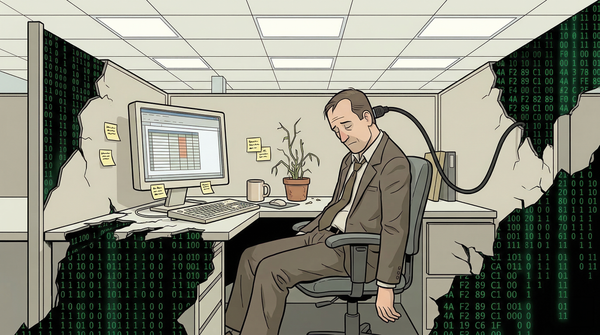
The idea of The Matrix is, of course, that reality is a simulation—that the world we perceive might be a constructed illusion masking something truer and more terrible.
What Gopnik shows is that this isn't a new idea at all.
He traces it from the medieval Cathars, who "were sure that the material world was a phantasm created by Satan," through Philip K. Dick's paranoid fictions, through academic philosophy's "brain-in-a-vat" thought experiments, all the way to Baudrillard, whose books "popularized the view that reality itself has become a simulation."
The genius of The Matrix, on Gopnik's account, was in finding the perfect vessel for this centuries-old anxiety. Two pills: the red one, the blue one. Morpheus's offer to Neo...
You take the blue pill, the story ends, you wake up in your bed and believe whatever you want to believe. You take the red pill . . . and I show you how deep the rabbit hole goes
...crystallized a philosophical tradition into a single memorable choice. The film didn't invent the idea; it memefied it.
And the deeper function of the essay is not merely a review of the film; instead, it draws out its intellectual legacy.
Why It Lasted
The essay's deepest insight comes near the end, where Gopnik explains why the speculation outlasted the spectacle:
The idea that the world we live in isn't real is one that speaks right now to a general condition. For the curious thing about the movie was that everybody could grasp the basic setup instantly. Whether it occurs in cult science fiction or academic philosophy, we seem to be fascinated by the possibility that our world might not exist. We're not strangers to the feeling that, for much of our lives, we might just as well be brains-in-vats, floating in an amniotic fluid of simulations. It doesn't just strike us as plausibly weird. It strikes us as weirdly plausible.
That phrase—"weirdly plausible"—is key to the film's success.
The film succeeded, on Gopnik's account, not because it shows viewers something alien but because it reflects back something they already believed, even subconsciously. The idea was not new to the culture. The film repackaged it.
Writing in 2003, Gopnik couldn't have foreseen how durable the red pill metaphor would prove. It's still everywhere—in political discourse, in online communities, in everyday speech.
But that longevity extends his point: the film's staying power had nothing to do with its visual effects, which even today seem dated; or its action choreography, which others have emulated and surpassed.
It had to do with the idea it gave people to carry around and use.
The Lesson for Writers
This is something I come back to constantly in my own teaching: ideas don't live in texts. They live in readers.
A piece of writing—an essay, a film, a book—is a mechanism for transferring an idea from the writer's mind into the reader's. If the idea is useful, it will be adopted by a community of readers. They share it amongst themselves. They use it to make sense of their experience, to correct misunderstandings, to argue with friends. The text gets left behind; the idea travels. That's how a single line from a movie becomes cultural shorthand.
Gopnik's essay doesn't just review The Matrix. It treats the film as a container, the latest version of an idea that just won't quit, and asks why that idea reincarnated in our cultural discourse at this particular moment. His answer points beyond the film's technical achievement to something about the audience: what they already believed, what they were already afraid of, what they needed a name for.
The best nonfiction writers take a piece of culture their readers already care about and help them understand why they care about it.
As Gopnik puts it, the film's strength lay not in novelty but in recognition: "it showed us a new world" less than it "reminded us of this one."
That's a great move for cultural criticism: Find the enduring idea beneath the fleeting artifact.
That's a high ambition. It's also the right one.