
Expert Writing & Rules
You Want Writing Advice
There are no natural-born writers; everyone learns to write.
Well, not everyone.
Many writers can get away with the default style. They write the way they speak. They copy the style of others without thinking about why it works (or doesn't). And they churn it all through AI. And for them, that's fine.
But this doesn't work for expert writers.
By expert writer, I don't mean you're expert at writing; I mean you have domain expertise, and you're using writing to perform professional functions. Maybe you're...
- building a personal brand, but nobody's engaging with your content.
- publishing research, but you can't get reviewers to care.
- trying to join the conversation in your space and influence trends through thought leadership content.
If you use writing professionally, at some point, you need to learn to write.
(Maybe that's what brought you here in the first place.)
So, you seek out writing advice.
But what you find are lists of rules.
When you're shopping for writing advice, bare are the shelves in the marketplace of ideas.
You want writing help. But best they can do is writing rules.
For whatever reason, rules are the genre in which writing advice is dispensed to novices.
In other domains, novices are well served by a variety of genres. If you want to learn to cook or how to start a business, you won't find lists of rules. Novice cooks get how-to guides; novice entrepreneurs, case studies.
But if learning to write is what you want, then rules is what you get.
In particular, two writing rules are beloved by the writing mavens:
(1) Write shorter sentences. Long sentences are bad; short sentences are good. Your readers are very stupid, you see. They have no control over their attention. So you should write to them with language normally reserved for toddlers.
(2) Avoid passive verbs. Readers want to know who did what to whom, in that order. If you reverse the order, using the passive voice, then your readers will be helplessly confused, unable to untangle your riddled syntax (they are very stupid, recall).
Use active verbs unless there is no comfortable way to get around using a passive verb. The difference between an active-verb style and a passive-verb style—in clarity and vigor—is the difference between life and death for a writer.
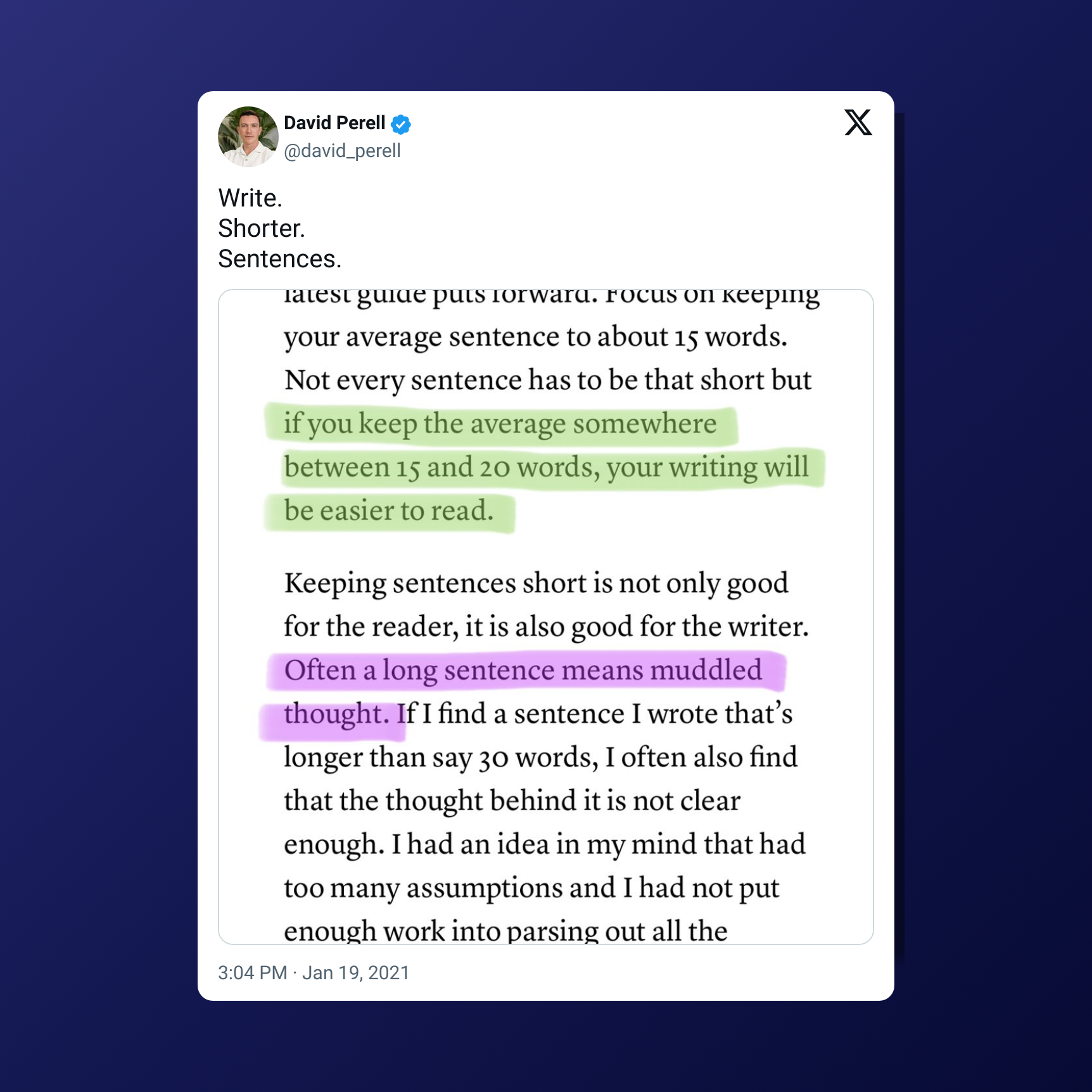
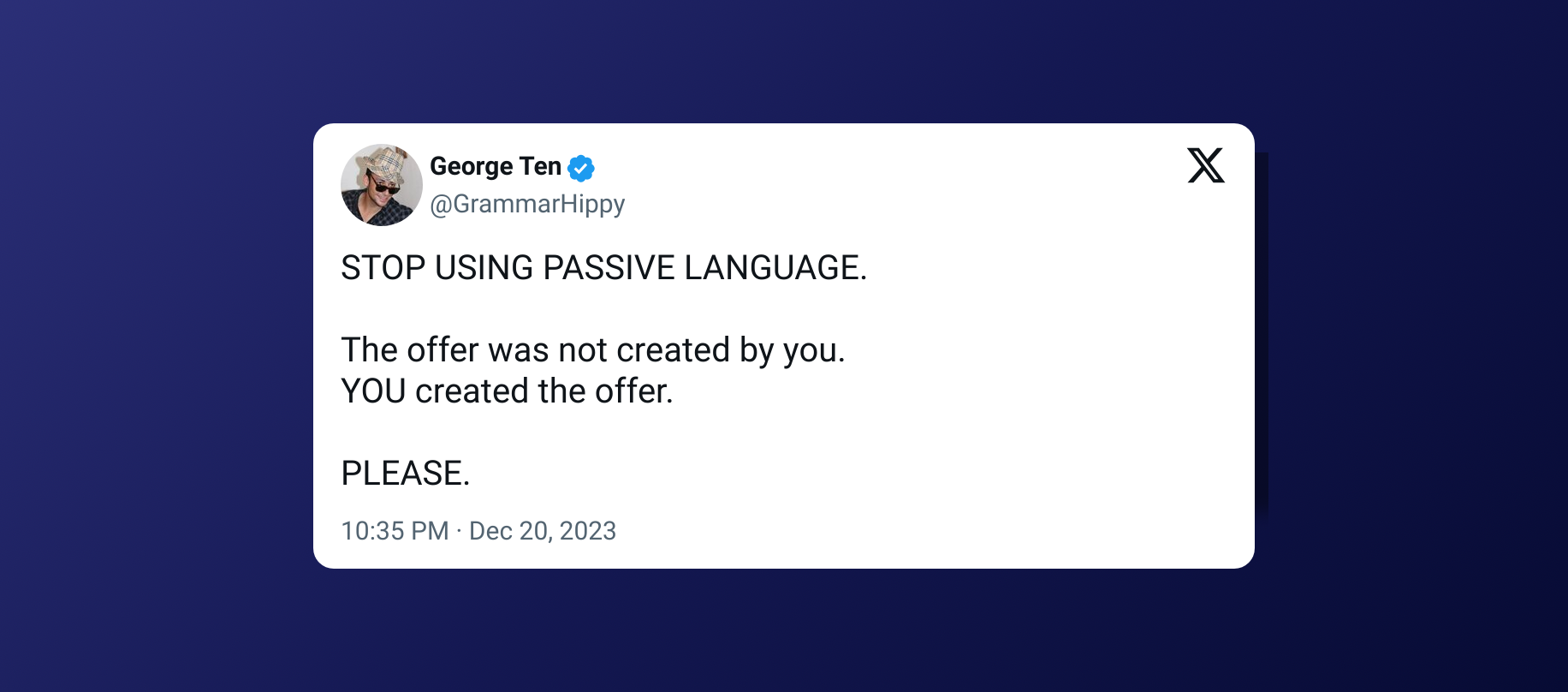
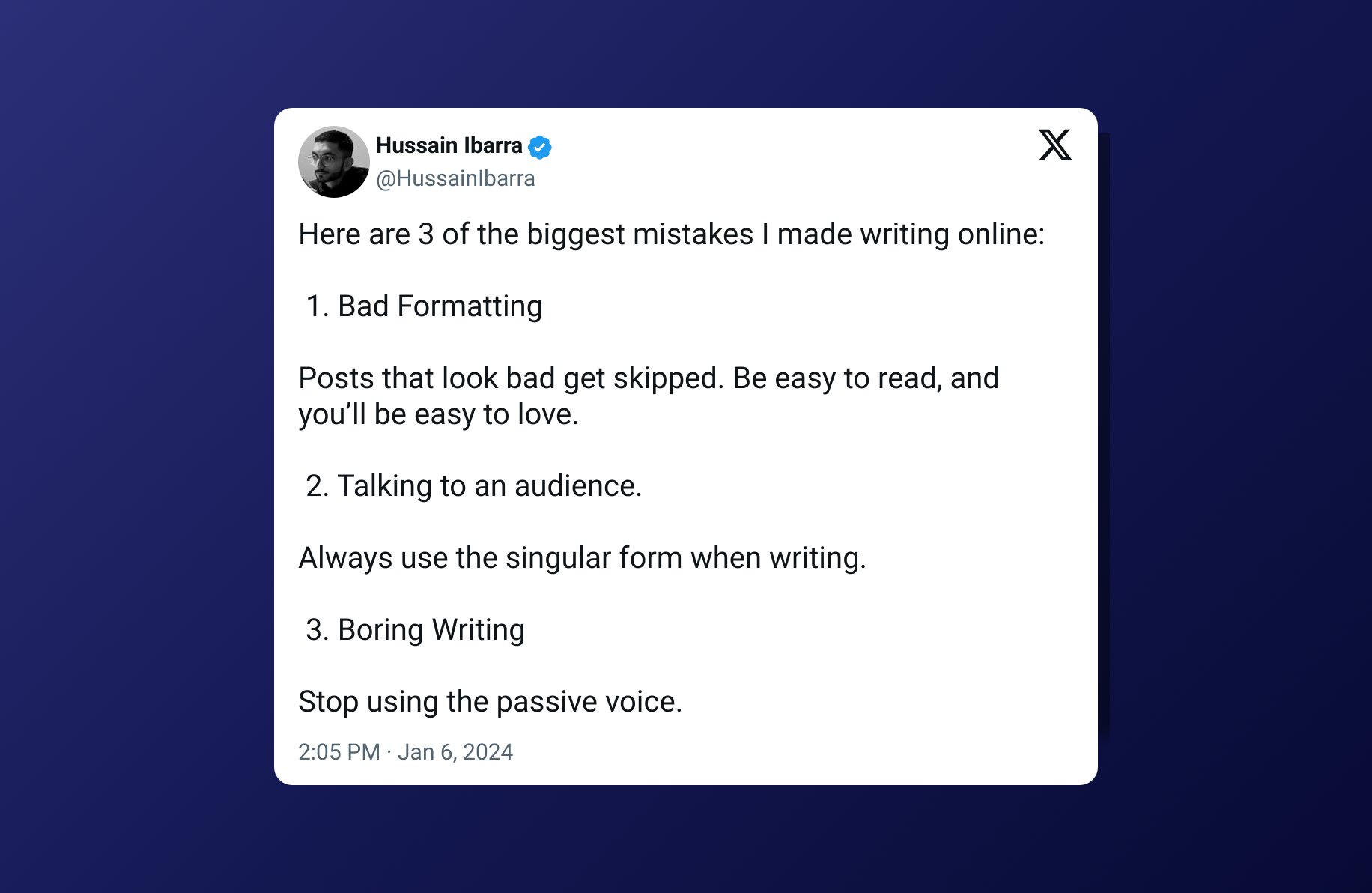
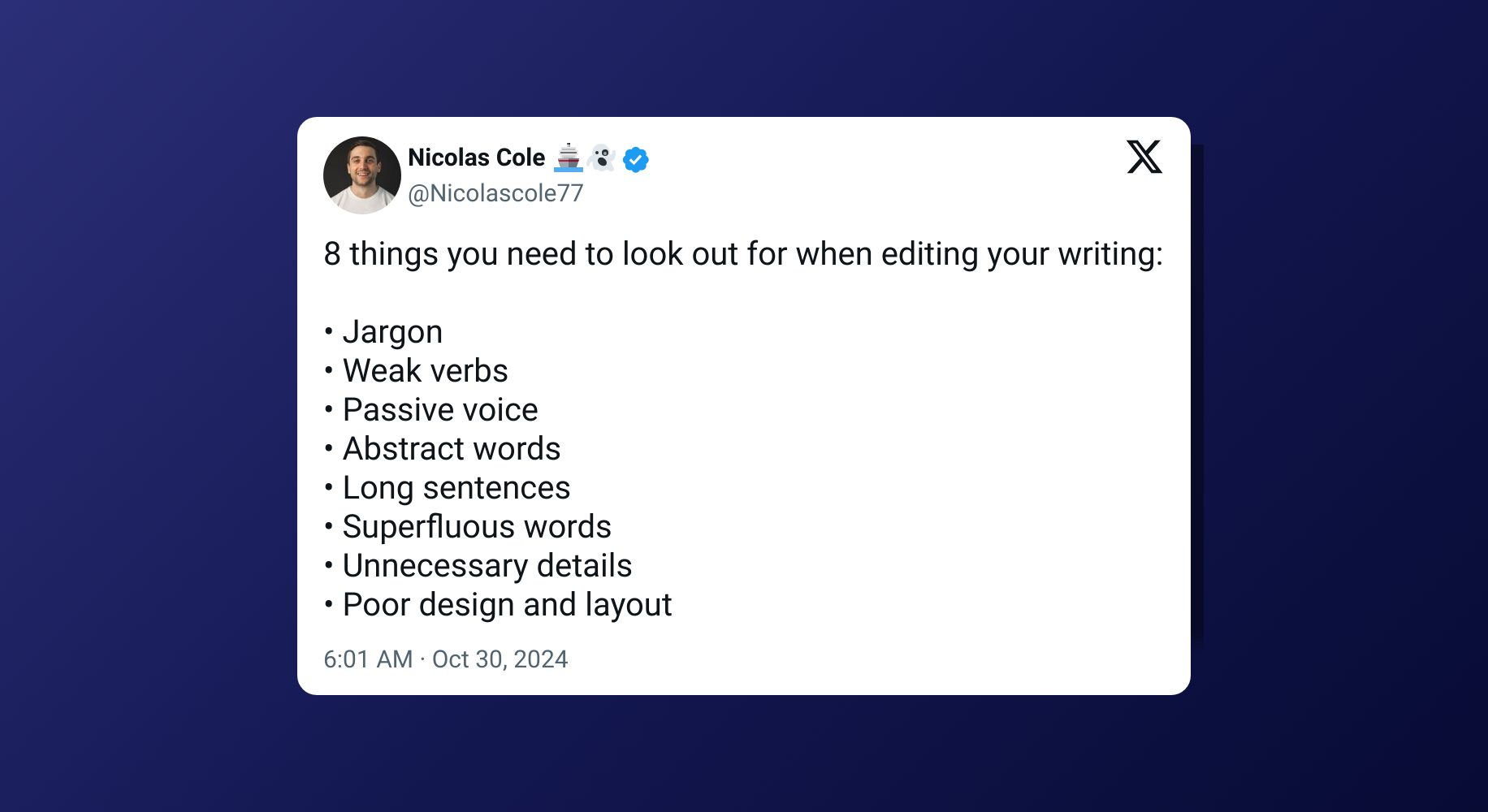
The Chorus: 'Writer shorter sentences, stop using the passive voice'
In short, these writing mavens would have you believe that the better sentence is the one that's shorter and active. Thus, on their account...
| (1) Bees make honey. (2) Honey is made by bees. |
...Sentence 1 is the better sentence.
The dangers of following writing rules
In calling out this genre of writing advice, I don't intend to quarrel about grammar. No one is served by my pointing out that some of these writing mavens are just parroting Zinsser or Strunk & White, many of them can't distinguish between the passive voice (a distinct grammar form) and passive writing (an abstract vibe that comes from intransitive verbs, gerunds, and nominalizations), or that most of them don't even follow their own advice.
My purpose instead is to highlight two dangers of following this genre of writing advice, and to suggest an alternative for expert writers.
First, the two dangers:
- They result in a specific kind of writing failure
- They train you to think about writing in the wrong way
A Specific Kind of Writing Failure
In the economy of your text there are three people:
- The writing teacher
- The novice writer
- The reader
Two of them are well served by writing rules like 'Write short sentences' and 'Avoid passive verbs'.
But these writing rules ignore the only one who counts.
Writing rules produce two kinds of value
Writing rules serve writing teachers and novice writers.
For writing teachers, their job is made much easier by writing rules.
Writing teachers have a tough job. They need to simplify a dynamic, inter-dependent system like a text. They don't want to tell you the truth (that all writing is not the same); they want to sell you the dream (that writing is easy, and you can too!).
For teachers, writing rules produce a certain kind of value: they give their market something it wants.
And for novice writers (said market), the anxiety of writing is quelled by writing rules.
When you're learning to write, there are so many things to learn. Syntax. Semantics. Rhetoric. It can seem quite overwhelming.
For novice writers, writing rules produce another kind of value: solid ground.
But readers value something different
Readers experience the text differently than writers do.
Writers view their text from above, like a map. They see the entire structure simultaneously. Every phrase, clause, and idea is perceived in a single quantum of time.
But consider your reader's experience.
Readers can't view the text from above. They navigating the structure turn by turn. Each phrase, clause, and idea unfolds with its own horizon of expectations and uncertainties.
So, for example, when your reader reads these sentences...
| (1) Bees make honey. (2) Honey is made by bees. |
... they don't read them all at once; they experience them as unfolding through time. Each quanta of time pays off a previous expectation and sets up a new one.
Bearing in mind that phenomenology of reading, consider your reader's experience in these two scenarios:
Scenario #1:
Imagine your reader cares about bees.
He wants to think about bees. He's using your text in order to think about bees.
And imagine this reader is given Sentence One:
| Bees. Yes, interesting, what about bees? Bees make. Okay, I'm with you, what do bees make? Bees make honey. Got it. |
This reader has found value in Sentence One.
But why is Sentence One valuable?
Ask the writing mavens, and they'll tell you that Sentence One is valuable because it adheres to their rules of writing. After all, it's shorter than Sentence Two, and it uses an active verb. What's not to love?
But ask your reader, and you'll find he values something different.
Your reader values Sentence One because it helps him think about what he cares about.
The reader is interested in bees. And Sentence One helps him think about bees.
Scenario #2:
Now imagine that your reader doesn't care about bees. What he cares about is honey. He wants to think about honey. He's using your text in order to think about honey.
But Sentence One begins in time by mentioning bees.
| Bees. Wait, why are you telling me about bees? I'm here for the honey. Bees make. Where is this going? Bees make honey. Ah, got it. |
Your reader is interested in honey. He wants to think about honey. He's trying to use this text to think about honey.
But the text doesn't care about honey; it's primarily interested in bees.
So now your reader needs to do a bit of extra work. He backtracks. He translates Sentence One (about bees) into something he can use (to think about honey).
Ask the writing mavens, and you'll find that Sentence One is still masterful.
But ask this reader, and you find that Sentence One doesn't produce value; it produces only frustration. The fact that Sentence One is short and active is beside the point.
You're following rules instead of creating value
That's one danger of listening to the writing mavens: They train you to think of your writing in terms of universal rules for universal readers.
But since there are no universal readers, there can be no universal rules.
And to be fair, the writing mavens know this. They respond: Well, of course, there are exceptions. Yet those exceptions disprove the rule.
The writing mavens know the exceptions—because they're the mavens! They have an alarm bell in their head that goes off whenever a particular writing rule would work against their purpose.
But experts don't share their discretion. They've spent their time developing domain expertise; they don't have time to learn the craft of writing as well. That's why they turn to the mavens.
The writing mavens lead novice writers astray. They teach rules because it makes their job easier, and because novices desperately want some solidity to grasp.
But their teaching trains writers to think that rules produce value.
They don't.
The Wrong Way to Think About Writing
If a tree falls in the forest, does it make a sound?
If a writer creates a text and no one reads it, does it make a meaning?
If you ask the writing mavens, the answer is: yes.
Writing Mavens think of language like flowers in a vase
If you believe in universal writing rules (like Avoid passive verbs or Shorter sentences are better), then you have to believe that language is like flowers in a vase.
The vase is a container that holds the flowers: language is a container that holds the writer's ideas.
The flowers and the vase exist 'out there' in the world; they don't require someone to behold them in order to exist.
And language works the same way, according to the writing mavens.
But unlike the flowers and the vase, the text and its meaning are not independent. If you swap out one vase for another, the flowers remain the same. But if you swap out one sentence structure for another, the meaning changes entirely.
Take a sentence like...
| Honey is made by bees. |
...remove the three flowers from the vase...
- Honey
- Bees
- Making
...and put them into a new vase:
| Bees make honey. |
And what do you get?
For the writing mavens, we have improved the sentence: shorter sentence, active verb.
For the reader, we have a completely different meaning.
If you write a sentence like Bees make honey, you're not depositing meaning into a container. You're giving readers an experience—one that asks them to focus on bees.
For readers who want to focus on bees, this experience is valuable.
But for readers who care about honey, no amount of stylistic changes to the text will improve upon that experience.
Writing is about functions, not forms
A better way to think about writing, I think, is in terms of functions, not forms.
Expert writers use writing to perform professional functions with real world results. When the text works, it succeeds in those functions.
You can have perfect form and perfect content, and the writing can still fail to achieve its functions.
For example, imagine you had a friend whose pet dog has died. You want to console your friend. So you say,
Aw don't worry about it, you can always buy another dog.
Now your friend is upset. Your text has failed in its function.
But how do we know?
That failure doesn't exist inside the text. We can't account for the failure by reference to the active voice or the length of the sentence. Your friend wouldn't feel much better if we switched the text from the active voice to the passive, or if we trimmed some of the length.
The failure exists in your friend and her reaction to the text. You wanted the text to console your friend, but it failed in that function.
The reader is the home of your ideas
Writing rules imagine meaning to be inside the text.
But it's meaningless to talk about meaning by focusing solely on the text.
Meaning exists only in the reader.
When we turn our attention away from the rules of writing, and when we focus instead on readers, we open up a new space of possibilities. We stop treating language as a static thing, and start using it to have real world outcomes.