Most experts I work with don't lack ideas. They lack permission.
They think, Yeah, I have ideas. But I'm not a writer.
They're waiting for a credential to tell them they're allowed to write.
But the solution to imposter syndrome isn't a credential; it's a stack of undeniable evidence.
In this issue...
- Stop waiting for permission to write ▶︎ Why credentials are the wrong test of expertise, and the test that actually counts.
- Write sentences your reader can follow on the first pass ▶︎ One principle from the psychology of learning, applied to your writing.
- Learn to spot the gaps in your draft (before readers do) ▶︎ The diagnostic procedure I use to transform drafts into clear writing.
✍️ It's the Tale, Not the Teller

It's Wednesday afternoon, and I'm at the pharmacy (came down with the flu this week) when a reader replies to my newsletter.
Normally I like it when readers reply.
But it seems that I got under one reader's skin.
He likes my work, he says. But he wishes I hadn't quoted the man I quoted.
I'll tell you who I quoted later.
For now, all you need to know is that plenty of my readers admire him, and plenty of them think he's ruining their country.
This reader is in the second group.
He wrote in good faith. He wasn't some ideological crank. He was just looking out for me.
But it reminds me of a line that I've carried with me since university, where I studied literary criticism. The line comes from D.H. Lawrence, the 19th century English novelist, and to paraphrase it:
Never trust the teller. Trust the tale.
It doesn't matter who says something, for Lawrence.
What matters is whether it's true, and whether it's useful.
But I don't want to fight with my reader.
Incidentally, I stopped fighting about politics after reading Jonathan Haidt's The Righteous Mind: Why Good People Are Divided by Politics and Religion. Haidt argues that our moral judgement, which form the basis of our political and religious beliefs, works like a rider on an elephant: intuition moves first, and reasoning follows, mostly to justify where the elephant was already going. So when we argue about politics, we rarely change anyone's mind; we're using logic (the rider) to argue with intuition (the elephant)—which is why judging the tale instead of the teller doesn't come naturally to anyone (including me).
Interpellation
Did you know that people who live near swamps hold more authoritarian attitudes?
Swamps have high rates of infectious disease; and where disease is common, wariness of outsiders and strict norms once helped keep people alive.
The effect of environment on political disposition is stronger than the effect of studying on grades.
When I learned that, I basically gave up thinking that I'd reasoned my way into any of my beliefs.
Anyway, then later that day, I'm on a call with a new client.
She's been asked to review a book for an academic journal. Not through a submission portal: the editors reached out to her personally.
But she isn't an academic. Grad school didn't work out for her. And she tells me she doesn't feel she belongs in that journal, that she's an outsider, that her ideas don't really count.
I'm listening, and it rings a bell.
She's doing exactly what my reader did: judging an idea by who's telling it.
Except the teller she's dismissing is herself.
And the people whose job it is to judge the tale—the editors—have already read her work and decided it was worth asking for.
Both of them are using the wrong test for an expert.
But an expert isn't someone with the right politics, and it isn't someone with the right credentials.
An expert is someone with something to add to the conversation.
What you add might come from research or from experience. The idea might not even be yours—it might come from a book, a mentor, or a man you can't stand.
What belongs to you is what you do with it: taking that idea and using it to move your group's conversation forward.
When the consultation with the client is over, I write back to my reader.
I tell him: it's the tale, not the teller.
And I tell him his letter gave me my next newsletter—because plenty of people have expertise but don't feel like experts, since they lack the credentials.
The idea isn't mine alone.
It comes from an unlikely group of voices, gathered around a table: there's D.H. Lawrence, my reader, my client, and—the politically charged person I quoted—Elon Musk (about whom more later).
The last line I write is this:
You don't need to be an expert to write; you become an expert through writing.
You have ideas worth sharing. I guarantee it.
If you're ready to bring those ideas into conversation with readers who matter, I'd love to help. Book in for 1:1 Writing Coaching→
And now, for the email that started this off:
🚀 Writing Clear Sentences (like Elon Musk)
Someone asked Elon Musk how he learns difficult things so quickly.
His response reveals something important about the way all minds work—including that of your reader.
Musk said:
It's important to view knowledge as a semantic tree. Make sure you understand the fundamental principles—i.e., the trunk and big branches—before you get into the leaves/details. Otherwise, there is nothing for them to hang on to.
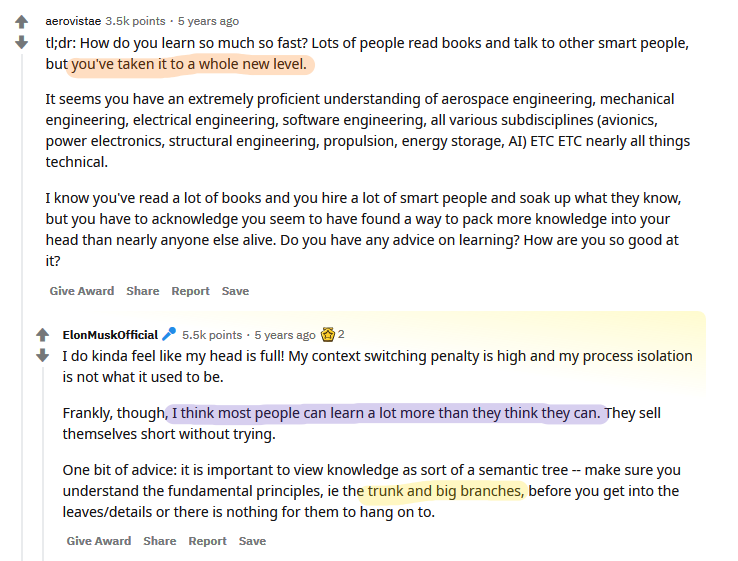
Great advice for rocket scientists.
But for writers, this is pure gold.
Like Musk, your reader wants to integrate your new information (the leaves) into their tree of knowledge.
When that integration is easy, they call your writing clear.
When it's difficult, they call your writing unclear.
For example: Imagine you're writing about temperature changes over time.
You could write it like this:
t=15’, T=32°C; t=0’, T=25°C; t=6’, T=29°C; t=3’, T=27°C; t=12’, T=32°C; t=9’, T=31°C
Or, you could organize the same information into a table:
| Time (min) | Temperature (°C) |
|---|---|
| 0 | 25 |
| 3 | 27 |
| 6 | 29 |
| 9 | 31 |
| 12 | 32 |
| 15 | 32 |
Which one’s easier to understand?
It's pretty obvious.
So it's the structure of the table that makes the information easier to read, right?
Not quite.
Because watch what happens if we flip the columns around, putting temperature first:
| Temperature (°C) | Time (min) |
|---|---|
| 25 | 0 |
| 27 | 3 |
| 29 | 6 |
| 31 | 9 |
| 32 | 12 |
| 32 | 15 |
Same structure. Yet suddenly, it's harder to read.
Why?
It's not the structure that makes it easier to read.
Clarity comes down to the way the information is organized within that structure.
Like Musk says: the leaves (details) need to connect to a branch (context) in your reader's tree of knowledge.
Readers expect old before new: familiar context first (time), followed by new or important details (temperature).
When you reverse that order (details first, familiar context last), the leaves have no branch to hang onto.
Consequently, your reader needs to hold these details in short term memory, waiting for the branch of context to arrive. That is, they have to work harder to integrate the information. They consider this writing to be unclear.
So if you want to write clearly, follow the Old→ New Principle:
- Old, familiar context first;
- New, important details last.
 William Fitzpatrick
➡️ Transform Messy Drafts into Clear Writing
Writers are often told to wait a day or two after writing a draft before revisions.
But an experiment from Carnegie Mellon shows a problem with this method.
Researchers seeded a technical document with logical gaps. They gave it to two groups of readers: those briefed on the subject, and those who read it cold.
Who do you think caught more of the errors?
Readers who were briefed on the subject caught fewer gaps than readers who came to it cold. This is because briefed readers were able to draw on their background knowledge to fill in the gaps left by the writer.
Every writer is the briefed reader of their own draft, and waiting a day doesn't change that.
So the gaps survive every revision.
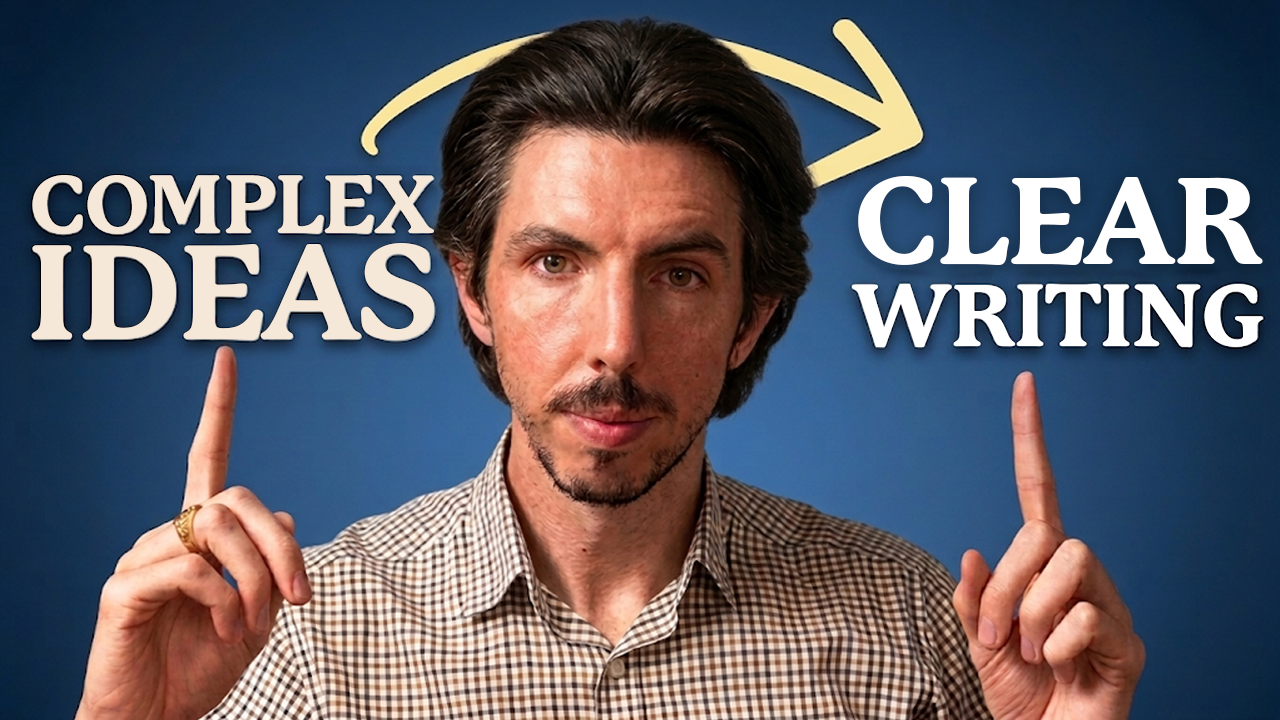
Rereading your draft won't show you the logical gaps. Instead, writers should check drafts with a procedure that doesn't depend on reading like a stranger.
This video provides such a procedure.
 William Fitzpatrick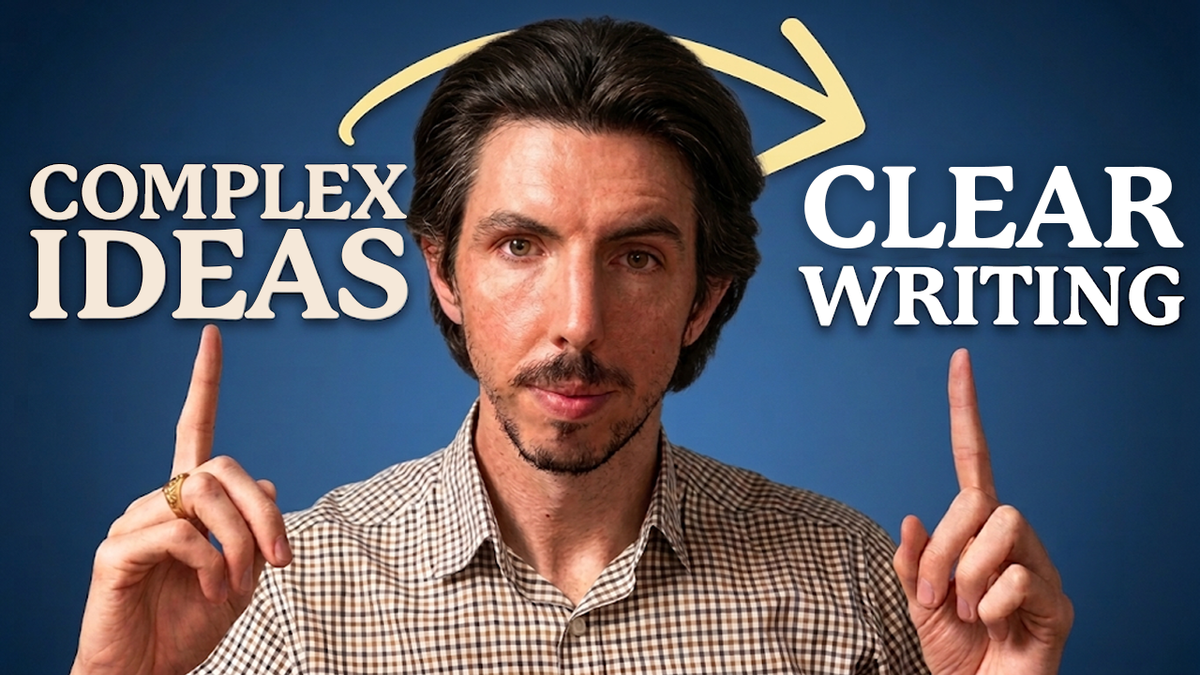
🧑💻 What We're Working On
Here are some recent projects I've helped writers with:
- A critical book review ▶︎ An academic journal invited a therapist to review a new book. The trouble was that the reviewer didn't like the book. The critiques were sharp, but the doubts were louder: Am I being unfair? Too Western? Not well-read enough? The editors asked for this review because they trust this person's judgment, so we skipped the doubts and went straight to the page. We're mapping published reviews from the field to learn the genre. Then we'll plan an argument that disagrees without being disagreeable. The only cure for impostor syndrome is evidence.
- A book about leaving a cult ▶︎ A historical novelist is writing about her years inside a spiritual organization, and she's writing for readers who are still in it. Her latest piece describes a tense afternoon with a friend who suddenly launches into conspiracy theories, and uses that afternoon as a mirror for ideological possession. The prose is already lucid and evocative. The hard part is empathy. Readers under a spell stop reading the moment they sense judgment. So I'm encouraging her to write every character—even the teacher she clashed with—with understanding rather than pity.
- The management book, continued ▶︎ A former executive turned business professor has his thesis and more than 100,000 words of case studies already drafted, so his problem isn't material. It's order. How do you wrangle all this material together into a text that readers can use? Instead of forcing a top-down structure, we're building the argument up from concrete evidence.
- The psychologist's next paper ▶︎ A child development researcher has a study about a certain concept in children from non-WEIRD countries. Journals kept rejecting it for overreaching. The introduction promises one thing and the discussion delivers another. So we're reframing that central concept as a precondition for a problem that his readers care about.
When experts treat writing as an extension of their thinking, the range of projects keeps widening.
If you're ready to get started with expert writing, book in for 1:1 writing coaching→
🌟 William's Choice
This weekend is Chuseok, the Korean national holiday for the harvest season.
But I was curled up sick on the couch.
At one point I stood up, stretched—and pulled a muscle in my back.
I grow old, I grow old.