First the robots came for the Programmers,
and I did not speak out—
for I was not a Programmer;
Then the robots came for the Copywriters,
and I did not speak out—
for I was not a Copywriter.
Then they came for the Writing Coaches...
March 2023: I'm on the bus, hunched over my phone, trying to make ChatGPT do the thing from the video.
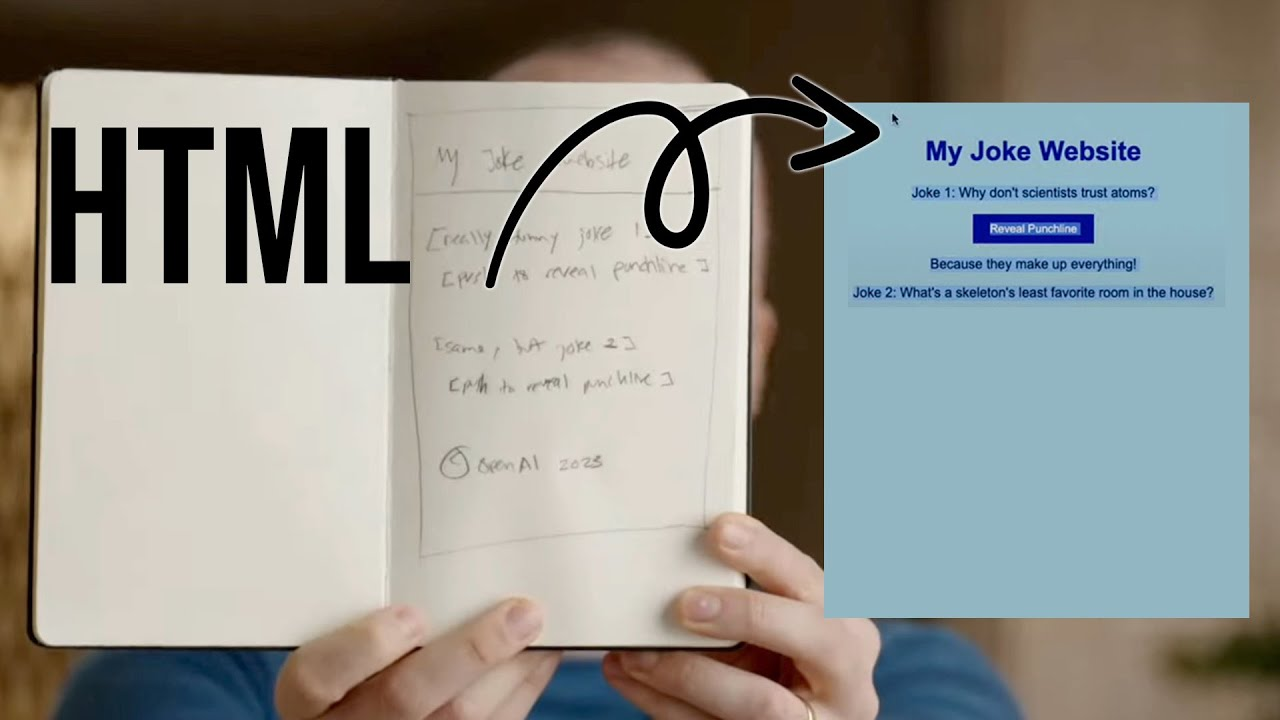
In the product demo, Sam Altman snaps a picture of a website he'd sketched on a napkin, and his new AI model turns the drawing into a website.
Nobody had ever seen anything like it before—so advanced, it was "indistinguishable from magic."
But the spell breaks for me there on the bus.
During my 2.5 hour commute to work, I'd been trying to get this new AI genie to help me escape the permanent underclass.
First we'll build a personal website.
Then... an app?
Then, profit!
So I sketch out my new website, just like in the video. Then I prompt ChatGPT to build it out.
Loading... Loading...
Hey, not bad.
On the surface, the website looks just like my sketch.
But the problem is, it doesn't work.
No problem. I prompt it again: Tweak this, change that. Make no mistakes.
Then it crashes. Alrighty. I fix that bug. Three more pop up.
By the time the bus reaches campus, I've given up.
The thought that surfaces is one that every one of my students is about to realize:
I'm an English professor at one of the top science & tech research institutes in South Korea. The only English-medium university in East Asia, it's a little English bubble in the Korean countryside.

When it comes to anything technical, my students are off-the-charts smart.
But with writing, they need some help.
My job: help Korean scientists communicate the value of their ideas to readers who matter—colleagues, investors, committees.
Their writing has stakes.
When writing fails, labs lose funding. Proposals get rejected. Professors miss tenure.
When they want to publish their research in international journals, I'm the one they call.
When they want to raise funding for new projects, they come to my office.
When they want to win grants, scholarships, and prestigious postdoc positions, we get to work.
Most of them think of me as a translator: someone who cleans up the grammar and makes the English sound native.
But for years I'd been telling them that good writing isn't about translation. I'd say, again and again:
The value of your writing is never going to come from the words alone.
And for years they've smiled politely and ignored me.
Like many writers, they'd been trained on a broken model of writing.
And now, that model is being put to the test by the advent of AI.
When I walk into the lobby, I see Kyungsub standing by the elevator.

A graduate student in materials science, Kyungsub has been working with me in the writing lab on his application to postdoc positions in the US.
In fact, we have an appointment later today.
"Have you tried it?" I ask, holding up my phone.
"It's incredible," he says. "I used it last night to edit my personal statement."
"Oh, how'd it go?"
"It was perfect."
"Really? I couldn't get it to work..."
"Actually, that reminds me," says Kyungsub. "Thanks to ChatGPT, I won't need our meeting after all. I sent in my application earlier this morning. It's all good."
Is it, though?
Kyungsub thinks he doesn't need my help anymore. The robots solved writing.
And under the model of writing he was taught, he's right.
Like many writers, Kyungsub believes that writing is a medium of transfer, like one of those pneumatic tube systems you see in department stores.
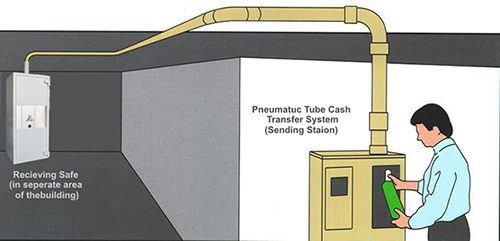
It works like this:
- You've got a valuable idea, like a wad of cash.
- That idea is deposited into words, like cash into a capsule.
- Those words are transferred across space and time through your text, like the pneumatic tube system.
- The reader extracts the value from those words, like cash from the capsule.
Good writing, according to the tube model, is clear transmission. It's good tubes.
Like a good tube system, good writing is clear, organized, and flawless.
And let's be honest: if that's all writing is, then it's hard to argue that AI writes badly. It's absolutely the case that AI writing is clear, organized, and flawless.
But baked into the tube model of writing is a crucial error:
And that assumption leads to writing that is clear, organized, flawless—and useless to readers.
If your writing is clear and useless, it's useless.
If it's organized and useless, it's useless.
If it's flawless and useless, it's useless.
Like the website I made on the bus, a text can appear slick and still fail. Because, from the reader's perspective, it doesn't matter how the text looks.
The relevant question is: Does it work?
Six weeks later, Kyungsub is back in my office.
"How'd it go," I ask knowingly.
Writing coaches are like divorce lawyers: if you're in my office, it's already too late.
"Rejected."
The disappointment is written on his face. This is no time for, See, told ya so! Though I must admit, the temptation is there.
For years I'd been repeating the same idea: The value of your writing isn't in the words.
But for years, that idea had fallen on deaf ears.
I know the value of my idea.
But I also know that my assessment of its value doesn't matter.
And now that Kyungsub realizes what deep shit he's in, we can get to work.
"Let's take a look," I say.
Kyungsub has a strong application.
Yes, it's clear, organized, and flawless.
But it's got substance, too.
He has the expertise. He's a graduate student at one of the top science & tech research institutes in South Korea. Bright kid, great experience, solid grades.
He's also got an unfair advantage. His supervisor had trained in the same lab to which Kyungsub was applying.
It should have been a slam dunk.
"My application was perfect," he says. "Every word."
"But see—that's exactly the problem."
"You mean, I should have made some mistakes? to make it sound more natural?"
"No," I say. "Mistakes are beside the point. The words you gave them were indeed perfect. The problem is, words is all you gave them. You failed to give them the only thing that counts: value."
"What do you mean, value," he protests. "Look at all my experience. The value is right there, on the page."
"No," I say. "The value isn't on the page. It's in your reader."
Maybe you already know how Kyungsub feels.
Maybe you don't even use AI. You write every word yourself.
Your writing is clear. It's organized. Flawless. It perfectly expresses your ideas.
Yet it still doesn't work.
You hit publish, and no one reads. Or they read, and nothing happens.
Your writing isn't doing what you want it to do.
It's not your expertise. It's not your writing style. And it's not your fault.
It's your broken model of writing: You're hitting the pool ball with a crooked stick.
Everything changes when you stop thinking about writing in terms of clarity, and start thinking about it in terms of value—when we turn away from the text, and toward the reader.
Readers don't read your words. They look straight through them.
In the next issue of Writer Science, I'll show you what they're looking at.
Until then, I'll leave you with a thought from a 2024 conversation between the economist Tyler Cowen and the investor Peter Thiel.
"Large language models are already quite powerful," Cowen says. "They're only going to get better. In this world to come, will the wordcels—the people who write, who play with ideas—lose their influence?"
"My intuition is just the opposite," Thiel answers.
It seems much worse for the math people than the word people.
The robots came for the Writing Coaches.
And, Reader—they missed!
Yours/William