Why do readers get lost in your writing, even when your points are good?
You've got the ideas and the experience to deliver value, but your writing feels dense. Readers have to go back and reread, and they still miss your points. Yet you can't say exactly what's wrong, because most writing advice focuses on sentences. It doesn't show you how your ideas are supposed to fit together.
I found the best framework for fitting them together in an unlikely place: The Elements of Academic Style, a book Eric Hayot wrote for professors of literature. Hayot calls the framework the uneven U. It's now one of my favorite frameworks to teach the researchers, consultants and independent writers I coach, because it keeps readers with you in any nonfiction genre.
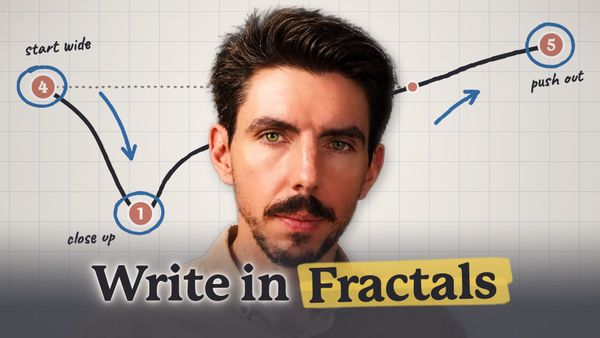
The uneven U works like a camera. A paragraph that flows starts with a wide shot, pushes in for a close-up on the evidence, and then pulls back out, ending at a higher level than where it began. Readers experience that movement as flow.
This video shows you that shape, how to apply it to a paragraph, and how the same shape holds when you zoom out to a section, a chapter or a whole book. Our model paragraph comes from "Increasing Returns and the New World of Business," one of the most popular articles the Harvard Business Review has ever published.
Go Deeper
- The Elements of Academic Style: Eric Hayot's book, the source of the uneven U
- Writing in fractals: the same shape at every level, from paragraph to book
- The Kuleshov effect: why a paragraph's opening tells readers how to read everything after it
- Hit-and-run quotations: Graff and Birkenstein's name for evidence you drop and drive away from, in They Say / I Say
- "Increasing Returns and the New World of Business": W. Brian Arthur's 1996 Harvard Business Review essay, the model paragraph in this video