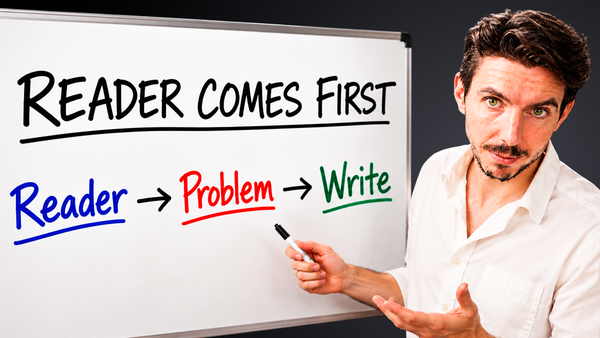
Who is my reader?
It's the question that stalls more writers than any other, and training doesn't make it go away.
A reader emailed me about it recently. He'd taken one of the big online writing courses and later became a mentor in it, so he'd been trained to train other writers. Yet he still couldn't answer it:
The biggest problem I'm facing as a writer now is knowing who my reader is. I tend to be quite experimental with my nonfiction… I just write for myself. In your words, I'm having a conversation with myself in the corner.
He's not a beginner. He already knew why the question matters: if you don't know who your reader is, then you don't know what they already think, so you can't change their mind. What he didn't know was how to answer it.
That's because he learned the old way. The old way says to write about what you love and let the internet find your readers for you. In that model, the reader is the output of your writing. You write, you publish, and you wait.
The new way flips the order. You begin by choosing a problem, because once you've chosen a problem, you've already chosen your reader: the people whose beliefs your text unsettles. The reader becomes an input.
This video shows you why the old way leaves so many writers talking to themselves, how the consequence you choose to focus on produces your reader, and an exercise for borrowing the value words your readers already use.
Go Deeper
- The three parts of a problem: an instability, a cost, and someone who pays it
- The opening sequence: stasis, concession, instability, cost, then your point
- The function of writing: writing works when it changes your reader's ideas